
Whistleblowing procedure: how to investigate a concern and protect the person who raised it
For employers in England, Scotland and Wales: what the law requires after someone raises a whistleblowing concern and what it leaves to you, the procedure in nine steps from the first conversation to the board report, how long an investigation should take, and a free investigation playbook.
A whistleblowing procedure is how you handle a concern from the moment a worker raises it: you acknowledge it, decide what to do, investigate where needed, keep them updated, protect them from unfair treatment and record the outcome. UK law sets none of these steps for most employers. It protects the person who raised the concern, and it makes you liable when colleagues treat them badly for it, unless you took all reasonable steps to prevent it. If they bring a claim, it’s for you to show why you acted as you did, so your procedure and its record are your evidence.
| After a concern | What the law requires | What it leaves to you |
|---|---|---|
| Acting on it | Nothing, for most employers: GOV.UK says you’re not legally required to act on a disclosure. | Whether and how you respond. GOV.UK calls acting on it good practice. |
| Timescales | None in UK law. | Your own, in your policy, told to the person. The EU benchmark is 7 days to acknowledge and 3 months to give feedback. |
| Investigating | No set procedure, and no duty to investigate every concern. | Who investigates, how, and the report. |
| Their identity | Data protection law covers every record you keep. Banks and insurers under the FCA’s whistleblowing rules (SYSC 18) must be able to handle confidential and anonymous concerns. | Who knows their name. GOV.UK says share it only with those who need to know. |
| Feedback | None for most employers. Banks and insurers under SYSC 18 give it where it’s feasible and appropriate. | Updates and your decision, which GOV.UK’s guidance says to share. |
| Unfair treatment | No detriment or dismissal because of the concern, by you or by colleagues. You’re liable for colleagues unless you took all reasonable steps to prevent it. | How you prevent it: briefings, check-ins, acting on any sign. |
| A claim | 6 months to claim, where the act or dismissal happened on or after 1 October 2026. You must show why you acted as you did. Compensation for dismissal has no cap. | The record that shows it. |
| Records | Keep them only as long as you need them (data protection law). Banks and insurers under SYSC 18 keep a record of each concern and its outcome, and report to the board every year. | What you record, how long you keep it and what the board sees. |
What changed in 2026:
- 6 April: a disclosure about sexual harassment can be a protected disclosure, and GOV.UK published new guidance for employers on handling a disclosure.
- 1 October: workers have 6 months to bring a detriment or dismissal claim where the act or dismissal happened on or after that date, up from 3.
- 12 October: the government opened a consultation, until 8 January 2027, on a legal duty to have whistleblowing procedures and to follow up each concern. It isn’t law.
Whistleblowing or grievance: how to tell, and what to do when it’s both
Check what kind of concern it is first, because that decides which procedure applies.
When it’s whistleblowing
A worker makes a whistleblowing disclosure when they tell you something they reasonably believe shows one of these, and reasonably believe that raising it is in the public interest:
- a criminal offence
- someone failing to meet a legal obligation
- a miscarriage of justice
- danger to someone’s health or safety
- sexual harassment (since 6 April 2026)
- damage to the environment
- someone covering up any of these
It can be about something that has happened, is happening or is likely to happen, in the UK or abroad. They don’t need evidence before they raise it. A concern raised as a grievance, in an email or in passing can still be a whistleblowing disclosure. The Public Interest Disclosure Act 1998 put these rules into the Employment Rights Act 1996, as Part 4A.
When it’s a grievance
Acas’s Code of Practice describes grievances as concerns, problems or complaints that employees raise with their employers. A concern about their own situation alone, such as their pay, may be a personal problem that whistleblowing law doesn’t cover. It can still be whistleblowing if it meets the test above, including the public interest part.
When it’s both
- Ask them. If a grievance might contain a disclosure, check with the person who raised it. If they’re doing both, you might need to follow both your grievance procedure and your whistleblowing procedure (Acas).
- Confirm a switch in writing. If they raised a grievance by mistake and nothing in it needs the grievance procedure, write to say the grievance procedure has ended and your whistleblowing procedure has replaced it.
- Explain your decision. If you decide it isn’t whistleblowing, tell them why, so they can take it elsewhere if they still think it is, and still try to resolve it.
The Acas Code. For the grievance part, tribunals take the Acas Code of Practice on disciplinary and grievance procedures into account, and in a relevant case can increase an award by up to 25% if you unreasonably failed to follow it. The Code itself suggests a separate procedure for whistleblowing. A report of sexual harassment can be a protected disclosure and a harassment complaint at once, and our dignity at work guide covers investigating the complaint.
The whistleblowing procedure in nine steps
These steps follow GOV.UK’s guidance for employers and Acas’s guidance on responding to a disclosure and on investigations at work. UK law sets none of them for most employers, so each step says what the law does require and what good practice adds. Put your version, with your own names and timescales, in your whistleblowing policy.
- Acknowledge the concern and set your timescales
- Decide whether to investigate, refer or close it, and record why
- Choose an independent investigator
- Protect their identity, including when they stay anonymous
- Plan the investigation, gather evidence and interview everyone fairly
- Keep them updated and give feedback
- Write up the findings in a report
- Protect them from victimisation, with check-ins at 30, 60 and 90 days
- Close the case, keep the record and report themes to the board
Acknowledge the concern and set your timescales
What the law requires. No UK law sets a deadline to acknowledge a concern or to deal with it. From the first conversation, you must not treat the person badly for raising it.
Good practice. GOV.UK’s guidance says to act promptly, talk to the worker to understand the concern and explain how you intend to handle it, and let them bring a colleague or union representative if they want one. In that first conversation:
- Thank them for raising it, and confirm in writing that you’ve received it.
- Find out what worries them, what they’ve seen and who else knows.
- Tell them who will handle it, what happens next and when they’ll next hear from you.
- Ask whether they want their name kept confidential, and explain what that means in practice.
- Check whether anyone is at risk now, or whether evidence could be lost, such as CCTV footage that’s deleted after a set time, and deal with that first.
Your timescales. Put them in your policy and tell the person. For a benchmark, the EU Whistleblowing Directive gives employers there 7 days to acknowledge a report and 3 months from then to give feedback, and the government’s consultation describes the same clocks in Ireland’s law.
Decide whether to investigate, refer or close it, and record why
What the law requires. Nothing, for most employers. GOV.UK lists the options: investigate and, if necessary, act on any wrongdoing; refer the matter to an appropriate authority; or take no action. The choice still matters in law. If the worker later takes the same concern wider, for example to the media, a tribunal deciding whether that was reasonable looks at what you did, or might reasonably have been expected to do, about it (Employment Rights Act 1996, section 43G).
Proposed. The government’s consultation, open until 8 January 2027, floats a duty to follow up each concern with reasonable and proportionate steps to assess whether it has merit and decide what action, if any, to take. The government says that duty wouldn’t mean formally investigating every concern. It isn’t law.
Good practice.
- Assess it first. Check it against the test above, whether it’s also a grievance, how serious it is and who it involves. Ask the person for more information if you need it.
- Choose the route. Investigate it; pass it to another process, such as a grievance or disciplinary; refer it to an outside body, such as a regulator or the police; or take no further action. Some concerns need more than one.
- Decide with someone independent of the matter, and record the decision, who made it and why.
- Tell the person which route you’ve chosen and, if it’s no further action, why.
Choose an independent investigator
What the law requires. UK law doesn’t say who investigates. In the EU, the Whistleblowing Directive requires an impartial person or department to follow up each report.
Good practice. From Acas’s guidance on investigations at work:
- Pick someone not involved, such as another manager or someone from HR, so there’s no conflict of interest. If nobody is independent, make the process as impartial as you can.
- Match them to the case. Choose someone trained where possible, and someone more senior or experienced for a serious or complex concern, such as discrimination or bullying. Our workplace investigation training guide covers training the managers who investigate.
- Bring in an external investigator in exceptional cases, for an independent view. It can cost more and take longer.
- Write their terms of reference: what to investigate, whether to make recommendations, how to set out the findings and who to report them to.
If the concern is about a director, or about the person who would normally investigate, take it outside that line, for example to a non-executive director or an external investigator. Ask whoever you choose to confirm they have no link to the people or the matter. NHS England’s national speak-up policy asks for an investigator who is suitably independent, which might mean someone from outside the organisation, and trained in investigations.
Protect their identity, including when they stay anonymous
What the law requires. UK law doesn’t make most employers keep a whistleblower’s identity confidential, and GOV.UK calls doing so best practice. Data protection law covers everything you record about the concern and the people in it: you need a lawful basis to keep it, and you must keep it secure and limit access (ICO, Acas). UK banks and Solvency II insurers must be able to handle concerns where the person asks for confidentiality or doesn’t give their name (FCA SYSC 18). In the EU, the Directive bars sharing a reporter’s identity beyond the staff handling the report without their explicit consent.
Good practice.
- Share their identity only with the people who need to know, such as HR and the senior managers handling it (GOV.UK).
- Agree with them who will know their name, and tell them before that changes.
- Think about what else could identify them, such as the date, their team or a detail only they would know, and leave it out of anything others see.
- Keep the case file apart from their personnel file, with access limited to the people handling it.
Anonymous concerns
GOV.UK says an anonymous concern is harder to investigate and may limit the feedback you can give. You can still assess it and act on what it tells you. To ask questions or send updates, you need a route that lets you reply without knowing who raised it, and our anonymous reporting guide shows one in Slack and Teams. Don’t try to work out who they are.
Plan the investigation, gather evidence and interview everyone fairly
What the law requires. No law sets how you investigate a whistleblowing concern. Data protection law covers the evidence you gather and the people in it. If the findings lead to disciplinary action against someone, the Acas Code applies to that process: investigate without unreasonable delay and, where practicable, have different people investigate and hear the case.
Good practice. Acas wrote its guidance on investigations at work for discipline and grievances. It fits a whistleblowing concern too, with one addition: protect the whistleblower’s identity at every step.
- Plan it: what to investigate, who’s investigating, who to speak to, what evidence to gather, such as work records, emails or CCTV, anything you could lose, such as footage that’s deleted after a set time or someone going on leave, and your timeframe.
- Gather evidence from all sides. Be fair and objective, get as much information as is reasonable and keep the case confidential. Your aim is to find out what happened.
- Start with the person who raised it. Go through what they know and what they’d like to happen, and let them bring a colleague or union representative.
- Interview witnesses with neutral questions. At the start, explain who’s there and why, the investigator’s role, the purpose and the need for confidentiality. Record the answers, and any refusals to answer, and give each person their notes to check as their witness statement.
- Be fair to the person named. Tell them about the investigation as soon as you decide to start it, unless they might tamper with evidence or influence witnesses, and explain why, who is investigating, how long it could take and what happens next. Hear their side and keep an open mind, without revealing who raised the concern. The FCA’s guidance on training managers includes the steps that ensure fair treatment of anyone a whistleblower accuses of wrongdoing.
- Keep any conduct issue separate. If the findings point to misconduct, start a separate disciplinary process, with its own rights. NHS England’s national policy says the same of any conduct issue an investigation turns up.
Keep them updated and give feedback
What the law requires. No duty to give feedback, for most employers. UK banks and Solvency II insurers must give feedback where it’s feasible and appropriate (FCA SYSC 18), and in the EU the Directive gives employers 3 months from the acknowledgement.
Good practice. GOV.UK’s guidance says to keep the worker up to date and tell them your decision. Acas adds: answer their questions, or explain why you can’t, and give feedback after any investigation, explaining whether you took action.
- Agree with them how you’ll keep them updated, and how often.
- Tell them how long you expect the investigation to take, and explain any delay.
- At the end, tell them what you found and what changed, as far as you can. If you can’t share details, for example to protect someone else’s confidentiality, say so.
- For an anonymous concern, send updates through the route it came in, if that route lets you reply.
Write up the findings in a report
What the law requires. No law sets the form of a report. If the person later brings a claim for unfair treatment, it’s for you to show why you did what you did (Employment Rights Act 1996, section 48), and the report and your records are how you show it. UK banks and Solvency II insurers must keep records of each concern and how they treated it, including the outcome (FCA SYSC 18).
Good practice. Acas says an investigation report should set out:
- which facts were established
- which facts were not established
- any mitigating circumstances
- all the evidence collected
Keep it objective and concise, stick to the facts and explain any acronyms. The conclusions are the investigator’s own, and they can take advice from HR. If their terms of reference ask for recommendations, they can recommend formal action, such as a disciplinary hearing or a change to a policy; informal action, such as training, counselling or mediation; or no further action. If the information turns out to be untrue, GOV.UK says that doesn’t mean the person raised it maliciously. NHS England’s national policy adds that the report identifies any issues, to stop the problems happening again.
Protect them from victimisation, with check-ins at 30, 60 and 90 days
What the law requires. A worker has the right not to be treated badly, or dismissed, because they made a protected disclosure:
- By you or by colleagues. When a colleague treats them badly for it, the law treats that as done by you as well, whether or not you knew. Your defence is that you took all reasonable steps to prevent it, and the colleague can be personally liable (Employment Rights Act 1996, section 47B).
- Dismissal for it is automatically unfair, with no minimum length of service and no cap on compensation (sections 103A, 108 and 124).
- You must show why. In a claim for unfair treatment, it’s for you to show why you did what you did (section 48).
- 6 months to claim, from each act, or the last in a series, where it happened on or after 1 October 2026. For earlier acts, it’s 3 months. A claim can come long after the concern.
In 2024, 29% of UK employees who reported misconduct at work faced retaliation (Institute of Business Ethics).
Good practice.
- Brief the managers who know. Tell them what counts as unfair treatment, using Acas’s examples: bullying or harassment, turning down their training requests or passing them over for promotion without good reason, or cutting their hours. Remind them they can be personally liable.
- Check in at 30, 60 and 90 days. Ask how managers and colleagues have treated them since they raised it, note each check-in and act at once on any sign of unfair treatment.
Close the case, keep the record and report themes to the board
What the law requires. Data protection law sets no fixed period for keeping the records: keep them only as long as you need them, and set the period in a retention schedule (ICO). UK banks and Solvency II insurers must keep records of each concern and its outcome, report to the board at least once a year on how well their whistleblowing arrangements work, keeping whistleblowers’ identities confidential, and tell the FCA promptly about each tribunal claim they contested and lost on whistleblowing detriment or dismissal (FCA SYSC 18). In the EU, the Directive requires a record of every report, kept no longer than necessary and proportionate.
Good practice.
- Close it with the person. Tell them the case is closed, what changed as far as you can, and who to go to if anyone treats them badly for raising it.
- Keep one record: the concern, each decision and the reason for it, the investigation, each check-in and the outcome. If they later say someone treated them badly for speaking up, it shows why you acted as you did.
- Act on the lessons. NHS England’s national policy promises staff that lessons are shared across the organisation, and CQC expects leaders to share lessons and act on them.
- Report numbers and themes to the board at least once a year, naming nobody. Our ER metrics guide covers what to report and how to calculate it.
CalmER keeps every concern in one case log, shows trends across teams, sites and case types, and drafts a board pack from your live data for a person to sign off. See CalmER.
How long a whistleblowing investigation should take
No UK law sets a time for investigating a whistleblowing concern. Acas says an investigation should be finished as quickly as possible while staying thorough and fair: a simple case might take a day to gather enough information, and a complicated one several weeks. If your policy sets no timescale, set a reasonable one, tell the person and explain any delay, in the report too.
| Clock | UK law | EU Whistleblowing Directive |
|---|---|---|
| Acknowledge the concern | None | Within 7 days |
| Give feedback | None. Banks and insurers under SYSC 18: where feasible and appropriate | Within 3 months of the acknowledgement |
| Finish the investigation | None. Acas: as long as it takes to be thorough and fair | None set. Follow up diligently |
| Bring a claim for unfair treatment or dismissal | 6 months from the act or dismissal, where it happened on or after 1 October 2026 | Each country’s own law |
Ireland’s law, which the government’s consultation describes, adds more feedback every 3 months if the person asks. NHS England’s national policy promises a conclusion within a reasonable timescale that you tell the person.
Acas’s whistleblowing law page, last updated on 19 June 2026, still gives 3 months to bring a claim. The law changed on 1 October 2026, and Acas’s own page on tribunal time limits now gives 6.
Staff in several countries: which rules apply
The UK law in this guide covers England, Scotland and Wales, and the wrongdoing a worker reports can be in the UK or abroad.
- Northern Ireland has its own law, the Employment Rights (Northern Ireland) Order 1996, and its list of what counts doesn’t include sexual harassment.
- EU countries. Employers with 50 or more workers in an EU country need internal reporting channels and procedures that acknowledge reports within 7 days, name an impartial person to follow up, give feedback within 3 months, protect the reporter’s identity and keep a record of each report (Directive (EU) 2019/1937, articles 8, 9, 16 and 18). Each country’s law adds its own rules: Ireland’s, for example, adds feedback every 3 months if the person asks.
One procedure can work in every country if it meets the strictest rules you face, starting with the Directive’s: acknowledge within 7 days, give feedback within 3 months, and keep identities to the people handling the case. Our EU Whistleblowing Directive guide covers what each country requires.
What changes for FCA firms, NHS providers and care providers
FCA-regulated firms
SYSC 18 applies to UK banks, building societies and PRA-designated investment firms (except small deposit takers), and to Solvency II insurers. Their whistleblowing arrangements must at least:
- handle concerns where the person asks for confidentiality or doesn’t give their name, through a range of ways to report
- assess concerns and escalate them where appropriate, including to the FCA or PRA
- take reasonable measures so that nobody in the firm victimises the whistleblower
- give feedback where it’s feasible and appropriate
- keep records of each concern and its outcome, with written procedures UK staff can find easily
- report to the board at least once a year, keeping whistleblowers’ identities confidential, and tell the FCA promptly about each tribunal claim the firm contested and lost on whistleblowing detriment or dismissal
- train UK staff, their managers and the people who run the arrangements
Any other firm can adopt the rules as good practice, sized to fit. The FCA treats evidence that any firm acted to a whistleblower’s detriment as a serious matter, which can call the firm’s fitness and propriety into question. Our guide to the FCA’s non-financial misconduct rules covers when bullying and harassment breach its conduct rules.
Providers of NHS care
Adopt NHS England’s national speak-up policy and add your local details. It promises staff that you’ll thank them, discuss the concern, tell them how long any investigation will take and agree how to keep them updated; that someone suitably independent and trained investigates; and that you share the report where you can and act on the lessons. Our Freedom to Speak Up guide covers guardians, recording cases and reporting to the board.
CQC-registered providers
CQC’s well-led quality statement on freedom to speak up expects that staff who raise concerns, including external whistleblowers, get support without fear of detriment, and that leaders investigate concerns sensitively and confidentially and act on the lessons.
A whistleblowing investigation playbook that records every step, from first report to close
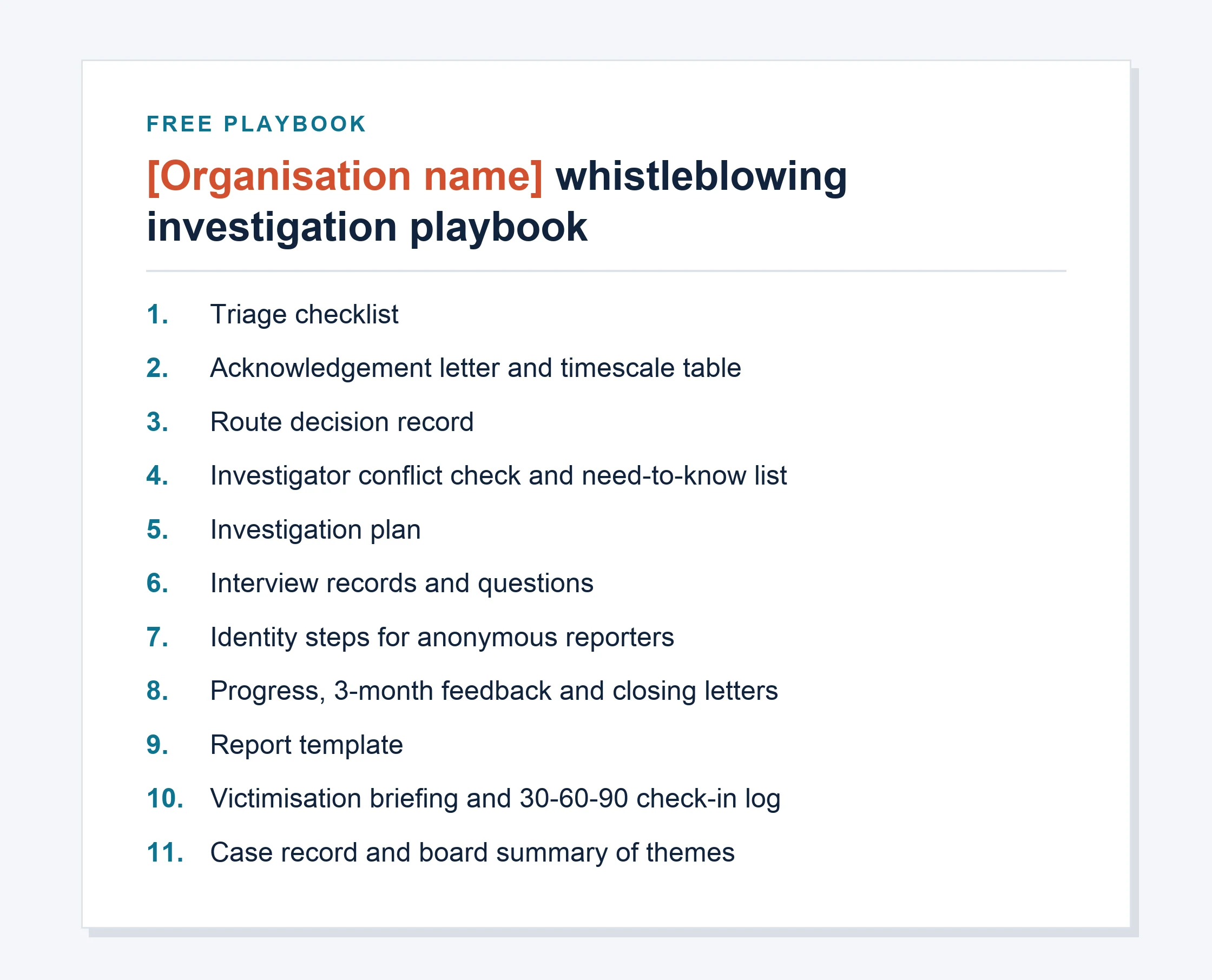
UK law leaves the procedure to you, and if a whistleblower later brings a claim, it’s for you to show why you did what you did. The playbook gives you the checklists, letters and records for each of the nine steps, ready for your own names, routes and timescales.
- A triage checklist: whistleblowing, a grievance or both
- Acknowledgement, progress, feedback and closing letters
- An investigation plan, interview records and a report template
- Identity steps for anonymous reporters, and a victimisation briefing for managers
- A 30, 60 and 90-day check-in log, a case record and a board summary of themes
Outcome: every concern handled the same way, with a record that shows why you acted as you did.
You fill in your own names, routes and timescales. No reporting tool included.
Request received
Thanks. Our team will be in touch within one working day to send your whistleblowing investigation playbook.
Could not send that request
Something went wrong on our side. Please try again, or use our contact form and our team will send you the playbook.
CalmER speak-up tools that give staff a safe route to speak up
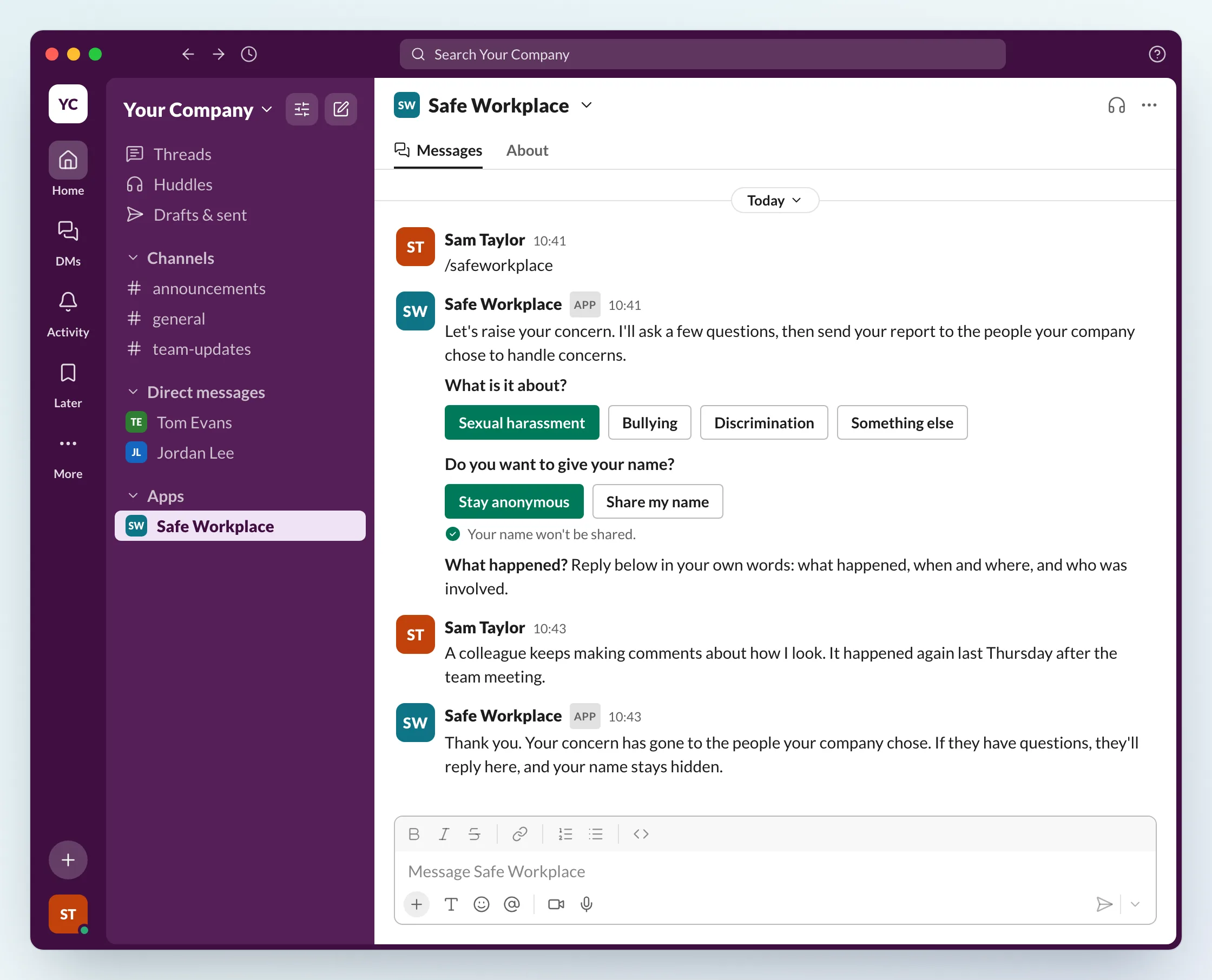
A whistleblowing procedure only works if staff can raise a concern safely, even about their own manager, and you can reply to them when they stay anonymous.
Our CalmER speak-up tools give them a credible, confidential way to raise a concern through Slack, Teams, email or WhatsApp, with an anonymous option where appropriate.
How it works in Slack or Teams
- Install the Safe Workplace app. An admin adds it to Slack or Teams once, and our team sets it up with you.
- Staff raise a concern in a private chat with the app. In Slack they type /safeworkplace, and in Teams they choose Raise a concern. They decide whether to give their name.
- It goes straight to the people who handle concerns. Each concern arrives in a private channel with only those people, and one of them picks it up.
- You reply, and they stay anonymous. The people handling it reply in the concern’s thread, and the app passes each question on. The person who raised it answers without giving their name unless they choose to.
- Every concern stays in one log. It shows each concern and how you handled it.
Outcome: fewer concerns stay unreported; a clearer, more accessible reporting route.
Moore Kingston Smith, an FCA-regulated accountancy and advisory firm, runs its whistleblowing on CalmER. Six months after go-live, early concerns had doubled and 91% of staff said they feel Safe Workplace protects their identity. Read the case study.
Enter your email to enquire. Our team will be in touch within one working day with the details for your organisation.
Enquiry received
Thanks. Our team will be in touch within one working day with the details for your organisation.
Could not send that request
Something went wrong on our side. Please try again, or use our contact form and our team will be in touch.
Common questions
What is a whistleblowing procedure?
It's how you handle a whistleblowing concern from the moment a worker raises it: you acknowledge it, decide whether to investigate, refer it or take no action, protect the person who raised it, keep them updated and record the outcome. UK law doesn't set these steps for most employers, so your procedure sets them, with your own timescales.
Do employers have to investigate whistleblowing concerns?
Not by law, for most employers. GOV.UK's guidance says employers are not legally required to act on a whistleblowing disclosure, and it calls acting on one good practice. The law protects the person who raised it either way. The government is consulting until 8 January 2027 on a duty to follow up each concern. It says that duty wouldn't mean formally investigating every one.
How do you investigate a whistleblowing complaint?
Choose someone independent of the matter and agree what they're investigating. Plan who to speak to and what evidence to gather, interview the person who raised it, any witnesses and the person named, and write up which facts were established and which weren't. Keep the person who raised it updated and protect their identity throughout.
How long should a whistleblowing investigation take?
No UK law sets a time. Acas says an investigation should be as quick as possible while staying thorough and fair: a simple case might take a day to gather enough information, and a complicated one several weeks. Set a reasonable timescale, tell the person who raised it and explain any delay. In EU countries, the person must get feedback within 3 months of the acknowledgement.
What happens in a whistleblowing investigation?
The investigator plans what to look into, gathers documents and other evidence, and meets the person who raised the concern, any witnesses and the person named, each of whom checks their own statement. The investigator then writes a report of the facts found, you decide what action to take, and you tell the person who raised it as much as you can.
Who should investigate a whistleblowing concern?
Someone not involved in the matter, such as another manager or someone from HR, and ideally someone trained. For a serious or complex concern, pick someone more senior or experienced, and for one about a director, someone outside that line, such as a non-executive director or an external investigator. NHS England's national policy asks for someone suitably independent and trained in investigations.
Do you have to acknowledge a whistleblowing concern within 7 days?
Not in UK law, which sets no deadlines for handling a concern. The 7 days to acknowledge and 3 months to give feedback come from the EU Whistleblowing Directive, for employers with 50 or more workers in an EU country. You can use the same clocks as your own timescales.
Can you investigate an anonymous whistleblowing concern?
Yes. GOV.UK says an anonymous concern is harder to investigate and may limit the feedback you can give. You can still assess it and act on what it tells you. To ask questions or send updates, you need a route that lets you reply without knowing who raised it.
Do you have to tell the whistleblower the outcome?
No law requires it of most employers. GOV.UK's guidance says to keep them up to date and tell them your decision. Tell them what you found and what changed as far as you can, and if you can't share details, for example to protect someone else, say so. UK banks and Solvency II insurers must give feedback where it's feasible and appropriate (FCA SYSC 18).
What if a whistleblowing concern is also a grievance?
Check with the person what they want dealt with. Acas says you might need to follow both your grievance procedure and your whistleblowing procedure. If they raised a grievance by mistake and nothing in it needs the grievance procedure, confirm in writing that the grievance procedure has ended and your whistleblowing procedure has replaced it.
What should a whistleblowing investigation report include?
Acas lists which facts were established, which weren't, any mitigating circumstances and all the evidence collected. The conclusions are the investigator's own. Keep it objective and concise. If the information turns out to be untrue, GOV.UK says that doesn't mean the person raised it maliciously.
How do you protect a whistleblower after an investigation?
Tell the managers who know who raised it what counts as unfair treatment, such as bullying them, passing them over or cutting their hours. Check in with the person at 30, 60 and 90 days and act at once on any sign. You're liable when colleagues treat them badly for raising it, unless you took all reasonable steps to prevent it, and they have 6 months from each act to bring a claim.
How long should you keep whistleblowing records?
Data protection law sets no fixed period. Keep them for as long as you need them, set that period in a retention schedule, store them securely and limit who can see them. The EU Directive says the same: no longer than necessary and proportionate.
Is there a whistleblowing investigation checklist or template?
Yes. Our free whistleblowing investigation playbook includes a triage checklist, an acknowledgement letter and timescale table, an investigation plan, interview records, a report template, progress, feedback and closing letters, a check-in log and a board summary of themes. Request it on this page, and our team will be in touch within one working day to send it.
What changed for whistleblowing in 2026?
Since 6 April 2026, a disclosure about sexual harassment can be a protected disclosure, and GOV.UK has new guidance for employers. Since 1 October 2026, workers have 6 months to bring a detriment or dismissal claim where the act or dismissal happened on or after that date. On 12 October the government opened a consultation on a duty to have whistleblowing procedures and to follow up each concern, which closes on 8 January 2027.
References
- Employment Rights Act 1996, Part 4A: protected disclosures
- Public Interest Disclosure Act 1998, section 1: protected disclosures added to the Employment Rights Act 1996
- Employment Rights Act 1996, section 43B: disclosures qualifying for protection
- Employment Rights Act 1996, section 43G: disclosure in other cases
- Employment Rights Act 1996, section 47B: protected disclosures and detriment
- Employment Rights Act 1996, section 48: detriment claims, the burden on the employer and time limits
- Employment Rights Act 1996, section 103A: protected disclosures and dismissal
- Employment Rights Act 1996, section 111: time limit for unfair dismissal claims
- Employment Rights Act 1996, section 124: no cap on compensation for whistleblowing dismissal
- Employment Rights Act 2025, section 23: whistleblowing on sexual harassment
- Employment Rights Act 2025 commencement regulations: tribunal time limits (SI 2026/954)
- Trade Union and Labour Relations (Consolidation) Act 1992, section 207A: failing to follow the Acas Code
- Employment Rights (Northern Ireland) Order 1996, article 67B: qualifying disclosures
- GOV.UK: Whistleblowing guidance for employers (6 April 2026)
- GOV.UK: Whistleblowing guidance for workers (1 October 2026)
- GOV.UK: Whistleblowing consultation (12 October 2026 to 8 January 2027)
- Acas: Responding to a whistleblowing disclosure (19 June 2026)
- Acas: Whistleblowing at work (19 June 2026)
- Acas: Investigations at work
- Acas: Code of Practice on disciplinary and grievance procedures (2015)
- Acas: Employment tribunal time limits (1 October 2026)
- EU Whistleblowing Directive (2019/1937), articles 8, 9, 16 and 18
- FCA Handbook: SYSC 18.3, internal arrangements
- FCA Handbook: SYSC 18.1, which firms the whistleblowing rules apply to
- NHS England: Freedom to Speak Up national policy (June 2022)
- CQC: Freedom to speak up (well-led quality statement)
- ICO: Collecting and keeping employment records
- Institute of Business Ethics: Ethics at Work 2024, UK results (archived)
General information, not legal advice. It reflects our understanding of the law and of GOV.UK, Acas and regulator guidance as of November 2026, so check legislation.gov.uk and gov.uk for the current position.