
Dignity at work policy: what to include, and how to handle bullying and harassment complaints
For employers in England, Scotland and Wales: what counts as bullying and harassment, what the law says, including harassment by customers and other third parties from 30 October 2026, what to put in your policy, how staff raise a concern, and how to investigate a complaint step by step, with a free dignity at work policy template.
Harassment at work is unlawful, and an employer is liable for harassment by its staff unless it took all reasonable steps to prevent it. From 30 October 2026, employers must also take all reasonable steps to stop customers, clients and other third parties harassing their staff. There’s no specific law against bullying, though bullying can be harassment. A dignity at work policy sets out how you prevent and deal with both.
| What | Where things stand |
|---|---|
| Harassment | Unlawful under the Equality Act 2010: unwanted conduct related to a protected characteristic, or of a sexual nature, that violates someone’s dignity or creates an intimidating, hostile, degrading, humiliating or offensive environment for them. |
| Bullying | No legal definition, and no specific law against it. It can be harassment when it relates to a protected characteristic, and severe bullying can contribute to a constructive dismissal claim. |
| Your liability | What your staff do in the course of their work counts as done by you, whether or not you knew. Your defence is that you took all reasonable steps to prevent it (Equality Act 2010, section 109). |
| From 30 October 2026 | You must not permit customers, clients or other third parties to harass your staff, and staff can bring a tribunal claim over it (Employment Rights Act 2025, section 21). |
| The policy | No law requires one by name. The EHRC puts an effective anti-harassment policy first among the steps it recommends, and one policy can cover every form of harassment if it tells them apart. |
| A complaint | Take it seriously and look into it as soon as possible. If in doubt, deal with it formally, through your grievance procedure unless you have a specific one. |
| Where to start | Our free dignity at work policy template. |
What counts as bullying and harassment at work
What bullying is
There’s no legal definition of bullying. Acas describes it as unwanted behaviour from a person or group that is either offensive, intimidating, malicious or insulting, or an abuse or misuse of power that undermines, humiliates, or causes physical or emotional harm to someone. It can happen once or as a pattern, face to face, on social media, in emails or calls, and it can still be bullying when the person doesn’t realise or mean it.
Examples of bullying at work
Acas’s examples include:
- constant criticism of someone’s work
- spreading malicious rumours about them
- putting them down in meetings again and again
- giving them a heavier workload than everyone else on purpose
- leaving them out of team social events
- posting humiliating, offensive or threatening comments or photos on social media
Bullying can also be upward, aimed at someone more senior such as a manager, by one person or a group. Acas’s examples of upward bullying include continued disrespect, refusing to do tasks, spreading rumours and constantly undermining the manager’s authority.
What harassment is in law
Harassment has a legal definition, in section 26 of the Equality Act 2010, and it takes three forms:
- Harassment related to a protected characteristic: unwanted conduct related to age, disability, gender reassignment, race, religion or belief, sex or sexual orientation, that violates someone’s dignity or creates an intimidating, hostile, degrading, humiliating or offensive environment for them.
- Sexual harassment: unwanted conduct of a sexual nature with the same purpose or effect.
- Worse treatment for rejecting or submitting to it: treating someone less favourably because they rejected or submitted to unwanted conduct of a sexual nature, or conduct related to sex or gender reassignment.
The effect counts as well as the purpose, so someone can harass a colleague without meaning to. In deciding the effect, the law looks at how the person saw it, the other circumstances, and whether it’s reasonable for the conduct to have that effect. Harassment law doesn’t cover pregnancy and maternity, or marriage and civil partnership.
Bullying can be harassment when it relates to a protected characteristic. GOV.UK’s examples of bullying or harassing behaviour include spreading malicious rumours, unfair treatment, picking on or regularly undermining someone, and denying someone training or promotion opportunities.
Signs to look out for
The EHRC’s harassment guidance lists warning signs that something may be wrong: sickness absence, a change in someone’s behaviour, comments in exit interviews, a dip in performance, and someone avoiding a colleague.
What the law says about bullying and harassment at work
Harassment is unlawful, and you’re liable for your staff’s harassment
An employer must not harass its employees or job applicants (Equality Act 2010, section 40). The law treats anything an employee does in the course of their work as done by the employer as well, whether or not the employer knew about it or approved it. The employer’s defence is to show it took all reasonable steps to prevent it (section 109).
Harassment by customers and other third parties
From 30 October 2026, an employer must not permit a third party, such as a customer, client or patient, to harass its staff. An employer permits it when the harassment happens in the course of the employee’s work and the employer failed to take all reasonable steps to prevent it. The rule covers all three forms of harassment, and staff can bring a tribunal claim over it. Our third-party harassment guide covers it in full.
The duty to prevent sexual harassment
Since 26 October 2024, employers have had to take reasonable steps to prevent sexual harassment of their staff, and from 30 October 2026, all reasonable steps. The Equality and Human Rights Commission enforces the duty. Our Worker Protection Act guide covers each step.
Bullying
There’s no specific law against bullying, and staff can’t bring a tribunal claim for bullying on its own. Acas says employers have a legal duty of care to protect their workers from harm, which includes dealing with bullying. When it relates to a protected characteristic, it can be harassment, and severe bullying that makes someone resign can contribute to a constructive dismissal claim.
Victimisation
Treating someone worse because they complained of harassment or discrimination, gave evidence, or helped someone else complain is victimisation, which is unlawful too (section 27). The law doesn’t protect a false complaint made in bad faith.
Whistleblowing, and FCA-regulated firms
Since 6 April 2026, telling your employer or a prescribed body that sexual harassment has happened, is happening or is likely to happen can be a protected disclosure, as long as the worker reasonably believes it’s in the public interest. Our UK whistleblowing policy guide covers what that means for your policies. If you’re an FCA-regulated firm, our non-financial misconduct guide covers when serious bullying and harassment can breach the FCA’s conduct rules.
Regulations to come
The Employment Rights Act 2025 lets ministers list steps that count as reasonable, such as publishing policies and handling complaints. The government expects to make those regulations in 2027/28, after consultation.
Is there a Dignity at Work Act?
No. A Dignity at Work Bill was before the House of Lords in 2002, and legislation.gov.uk lists no Act of that name. A dignity at work policy is an employer’s own policy on bullying and harassment.
What a dignity at work policy should include
The EHRC puts an effective anti-harassment policy first among the steps it recommends. You can keep separate policies, such as one for bullying and another for sexual harassment, or one policy that clearly tells the different forms of harassment apart. Either way, these are the parts to cover, from the commission’s technical guidance and Acas:
| Part | What it says |
|---|---|
| Our commitment | That you won't tolerate bullying or harassment from anyone, and that harassment is unlawful. |
| Who it covers | Everyone who works for you, at work, at work events and online, and harassment by customers, clients and other third parties. |
| What counts | Definitions of bullying and of each form of harassment, kept clearly apart, with examples that fit your workplace. |
| How to raise a concern | More than one route, named or anonymous, so nobody has to report to the person involved, and that a witness can raise a concern too. |
| What happens next | Informal and formal routes, no time limit for raising a concern, how you investigate, the timescales you aim for, the outcome and the right to appeal. |
| Confidentiality and support | How you keep a complaint confidential, including any investigation, and where staff can get support. |
| Discipline | That bullying or harassment can lead to disciplinary action, up to and including dismissal, and that abuse of power over a more junior colleague makes it more serious. |
| Protection from victimisation | That you won't treat anyone worse for raising a concern or helping with one, and that only a complaint that is both false and made in bad faith leads to disciplinary action. |
| Harassment by third parties | That you won't tolerate harassment by customers, clients and other third parties, how staff report it, and what you'll do, such as warning or banning a customer or reporting a crime to the police. |
| Monitoring and review | How you monitor the policy and how often you review it. |
Write it with your recognised trade union or other worker representatives, make it easy to find without asking a manager, and check your disciplinary, IT and social media policies match it, including on harassment through personal devices. The EHRC says to review policies every year.
How staff raise a bullying or harassment concern
Many staff stay quiet. In 2024, 37% of UK employees who knew about misconduct at work didn’t speak up, and of those, 40% feared for their job and 42% doubted anything would be done (Institute of Business Ethics). Most people who do speak up go to their manager: 68% of people who report misconduct tell their direct manager (Gartner, 2019). That route doesn’t work when the concern is about the manager.
The EHRC’s guidance on harassment sets out what helps staff speak up:
- More than one route, so nobody has to report to the person harassing them, and where possible a route to someone more senior than the person involved.
- Named or anonymous: a reporting system that lets staff raise an issue anonymously or by name. You can still act on an anonymous report, for example by reminding staff of the policy or monitoring the area.
- One record of every concern, formal and informal, kept centrally and confidentially.
- Regular chances to speak, such as one-to-ones, return-to-work meetings, exit interviews and staff surveys.
Acas adds that a complaint can come from a witness, about bullying or discrimination directed at someone else, or from a trade union or employee representative. Our guide to psychological safety at work covers what helps people speak up.
Give staff a safe route to speak up, in Slack, Teams, email or WhatsApp
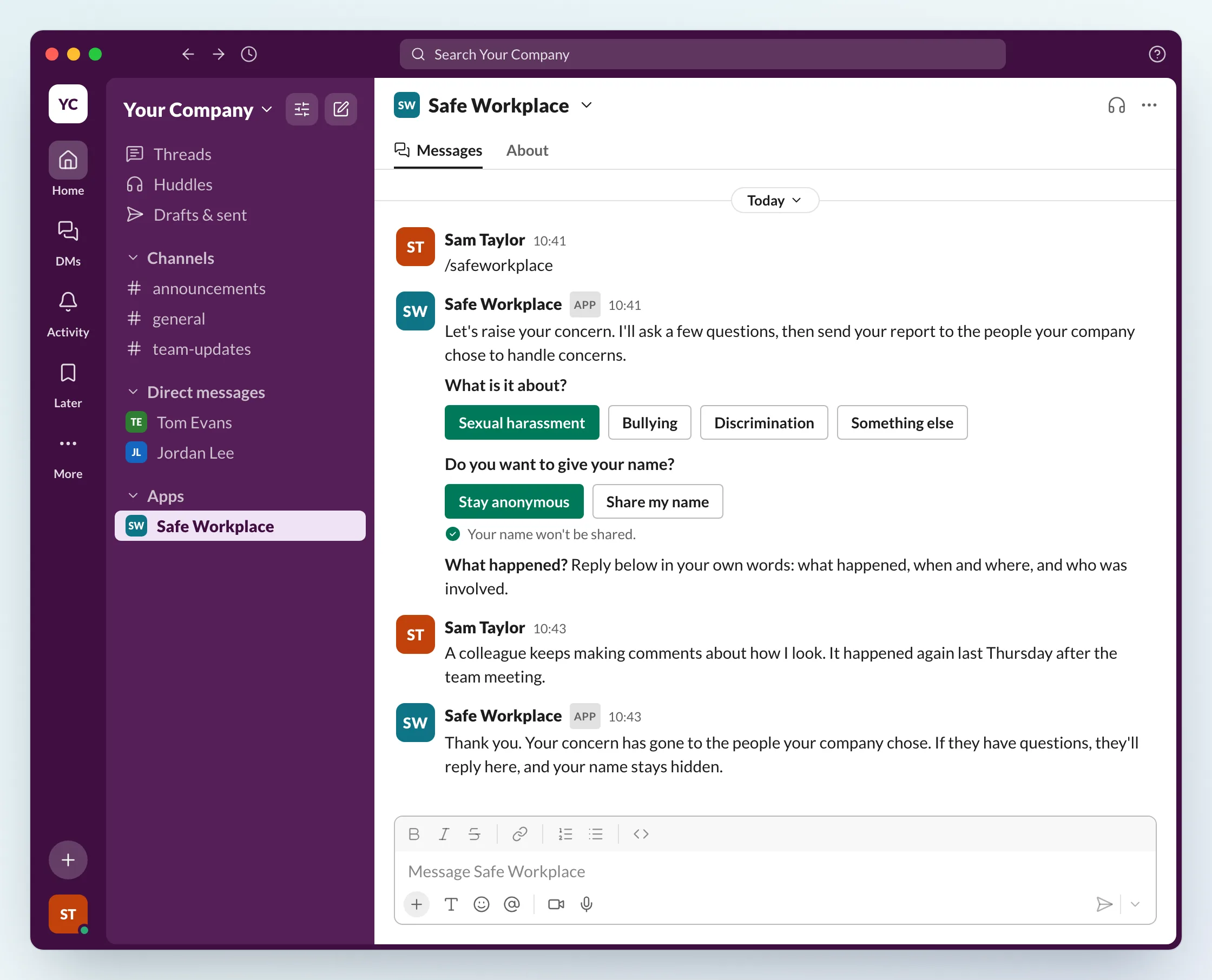
A policy only works if staff can act on it. CalmER gives them a credible, confidential way to raise a concern through Slack, Teams, email or WhatsApp, with an anonymous option where appropriate.
- Built-in workflows for harassment and ethics concerns
- Helps you be compliant with the Worker Protection Act
- Launch and promo material done for you
- New employee onboarding guide
Outcome: fewer concerns stay unreported; a clearer, more accessible reporting route.
Our team will be in touch within one working day with the details for your organisation.
Request received
Thanks. Our team will be in touch within one working day with the details for your organisation.
Could not send that request
Something went wrong on our side. Please try again, or use our contact form and our team will be in touch to book your 30-minute onboarding call.
How to handle a bullying or harassment complaint
Acas says to take any bullying or discrimination complaint seriously and look into it as soon as possible, even when someone raises it long after the event. If the person goes to an employment tribunal, the tribunal will take into account how you handled it.
- Check which policy applies. You may have one for bullying and another for sexual harassment: follow the one that fits the complaint.
- Talk to the person who raised it. Listen, keep an open mind and assume nothing. Let them bring a colleague or a trade union representative; at a formal grievance meeting, that’s their legal right.
- Agree with them how to handle it. Resolve it informally where you can. Handle it formally if they won’t try an informal approach, your policy requires it, it’s very serious or it could lead to disciplinary action. If you’re in any doubt, handle it formally.
- Use your grievance procedure for a formal complaint, unless you have a specific procedure for that kind of complaint, such as sexual harassment.
- Protect the person who complained. Don’t move them unless they ask, since a move they didn’t ask for could look like a punishment, and think very carefully before suspending anyone.
- Allow companions on both sides. Let the person complained about bring a companion to meetings that involve them, and see the evidence in time to prepare.
- Keep it confidential, including any investigation.
- Keep a record: the evidence, the steps you took, whether you upheld the complaint and why, and how you resolved it.
- Watch for victimisation afterwards. Treating someone worse because they were involved in a discrimination complaint is victimisation.
If the person asks you to take no action, the EHRC says to keep a record of the complaint and weigh the risk to them and to others before you decide. The grievance meeting, the decision and the appeal follow Acas’s grievance steps.
How to investigate a bullying or harassment complaint, step by step
An investigation finds out what happened, from all sides, so you can decide fairly what happens next. Acas says a decision made without a reasonable investigation is likely to be unfair, which risks legal action. These steps follow its guidance on investigations at work.
- Choose the investigator. Pick someone not involved in the case, such as another manager or someone from HR, and ideally someone trained. For a bullying or discrimination complaint, someone more senior or experienced may be best. In a small business where nobody is independent, the investigator must keep an open mind and carry out a fair investigation. An external investigator can bring an independent view in exceptional cases, though it can cost more and take longer.
- Set the terms of reference: what to investigate, whether to make recommendations, how to set out the findings, and who to report them to.
- Plan it. List who to speak to, the evidence to gather, such as emails, phone or computer records, or CCTV, anything you could lose, such as CCTV footage that gets deleted after a set time or a witness going on leave, and the timescale.
- Tell the people involved. Explain why you’re investigating, who’s doing it, how long it could take and what happens next, and that it must stay confidential. Keep them informed, especially about any delay.
- Gather the evidence you reasonably can, within data protection law and people’s right to privacy, and record how and why you got each piece.
- Hold investigation meetings. Invite people in writing with reasonable notice, meet in private, ask neutral questions and record the answers. Give each person their notes to check and sign as a witness statement. Use an anonymous witness statement only in exceptional cases, such as a genuine fear of reprisal.
- Write the report: the facts established, the facts not established, and any mitigating circumstances, with all the evidence. The conclusions are the investigator’s own.
- Decide what happens next. The options are formal action, informal action such as mediation or training, or no further action. Tell the person who complained the outcome in writing, with how to appeal. If the findings point to misconduct, start a separate disciplinary procedure.
How long a bullying investigation should take
As long as it needs to be thorough and fair. Acas says a simple case might take a day to gather enough information and a complicated one several weeks. If your policy sets no timescale, set a reasonable one, tell the people involved, and explain any delay in the report.
Or run every complaint to a fair, evidenced outcome
CalmER takes each bullying or harassment complaint from the first report to its outcome, with an audit trail of every step.
- Intake, in confidence. Staff raise a case through any channel, confidential if they choose, and CalmER acknowledges it instantly, with a clear owner from the start.
- The right route. CalmER suggests the proportionate route against your policy, informal first where it fits, and a named person accepts or overrides it, on the record.
- A consistent investigation. Guided, enforced investigation steps, with templates for grievance, conduct and performance.
- Investigations, written up. Every investigation report ends with a clean summary, a balanced findings section, recommended actions and the audit trail attached.
- An evidenced outcome. Every outcome links to the policy and precedent behind it, for a tribunal-ready record at the end of every case.
- Patterns, early. Every case connects to related people, teams and prior cases, so the pattern shows before the third complaint.
A dignity at work policy for bullying and every form of harassment
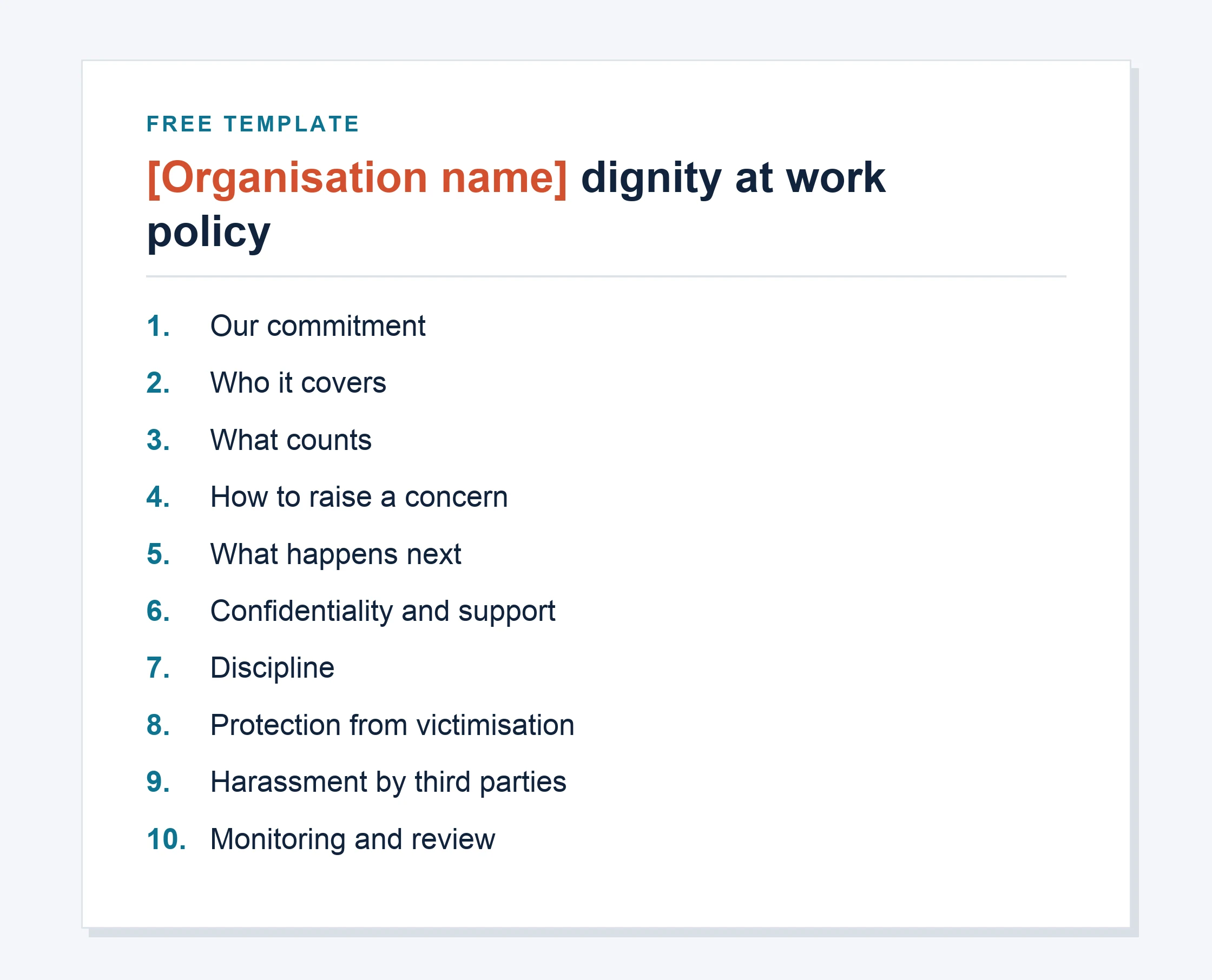
From 30 October 2026, the steps you take need to cover customers and other third parties as well as your own staff. This template covers bullying, every form of harassment and third parties in one policy, ready for your own names, reporting routes and examples.
- Who it covers, including customers and other third parties
- What counts as bullying and each form of harassment, with examples
- How to raise a concern, named or anonymous
- What happens next, from the first report to any appeal
- Discipline, protection from victimisation, and review
Outcome: one written policy that tells staff what counts, how to raise a concern and what happens next.
You fill in your own names, reporting routes and examples, and share it with your staff. No reporting tool included.
Request received
Thanks. Our team will be in touch within one working day to send your dignity at work policy template.
Could not send that request
Something went wrong on our side. Please try again, or use our contact form and our team will send you the policy template.
Earlier reporting, and every case on record
Moore Kingston Smith runs CalmER across all 8 of its offices. It tracks every case from first report to resolution with a full audit trail, and early concerns doubled within six months.
Amazon ran Safe Workplace’s case and concern management across its corporate workforce in more than 40 countries, and early-stage reporting tripled within 12 months. 70% of Amazon employees surveyed said they wouldn’t have reported through any previous route.
Thiess, the world’s largest mining services provider, uses Safe Workplace to comply with Australia’s rules on workplace bullying complaints, including the powers of the NSW Industrial Relations Commission.
Common questions
What should a dignity at work policy include?
Your commitment not to tolerate bullying or harassment; who the policy covers, including customers and other third parties; definitions of bullying and of each form of harassment, with examples; more than one way to raise a concern, named or anonymous; what happens next, from the first report to any appeal; confidentiality and support; discipline; protection from victimisation; and how you monitor and review it. One policy can cover bullying and every form of harassment if it clearly tells them apart.
Is a bullying and harassment policy a legal requirement?
No law requires one by name. Harassment is unlawful, and an employer is liable for harassment by its staff unless it took all reasonable steps to prevent it. The EHRC puts an effective anti-harassment policy first among the steps it recommends, and GOV.UK says anti-bullying and harassment policies can help prevent problems.
Is bullying at work illegal?
There's no specific law against bullying, and staff can't bring a tribunal claim for bullying on its own. It can be unlawful harassment when it relates to a protected characteristic, such as race, sex or disability, and severe bullying can contribute to a constructive dismissal claim. Acas says an employer's duty of care includes dealing with bullying.
Is there a Dignity at Work Act?
No. A Dignity at Work Bill was before the House of Lords in 2002, and legislation.gov.uk lists no Act of that name. The law on harassment at work is in the Equality Act 2010, and Acas's guidance covers bullying.
What is the difference between bullying and harassment?
Harassment has a legal definition in the Equality Act 2010: unwanted conduct related to a protected characteristic, or of a sexual nature, that violates someone's dignity or creates an intimidating, hostile, degrading, humiliating or offensive environment for them. Bullying has no legal definition. Acas describes it as unwanted behaviour that is offensive, intimidating, malicious or insulting, or an abuse or misuse of power. It can be harassment when it relates to a protected characteristic.
Can staff report bullying anonymously?
Yes, if you give them a way to. The EHRC's harassment guidance recommends a reporting system that lets staff raise an issue anonymously or by name, and says you can still act on an anonymous report, for example by reminding staff of the policy or monitoring the area. Our CalmER speak-up tools give staff a confidential way to raise a concern through Slack, Teams, email or WhatsApp, with an anonymous option where appropriate.
How long should a bullying investigation take?
As long as it needs to be thorough and fair. Acas says a simple case might take a day to gather enough information and a complicated one several weeks. If your policy sets no timescale, set a reasonable one, tell the people involved, and explain any delay.
Are employers responsible for harassment by customers?
From 30 October 2026, yes, where the harassment happens in the course of the employee's work and the employer failed to take all reasonable steps to prevent it. It covers sexual harassment and harassment related to a protected characteristic, and the employee can bring a claim at an employment tribunal.
Is there a free dignity at work policy template?
Yes. Request it on this page with your work email, and our team will be in touch within one working day to send it. It covers your commitment, who the policy covers, what counts as bullying and harassment, how to raise a concern, what happens next, confidentiality and support, discipline, protection from victimisation, harassment by third parties, and monitoring and review.
What do the CalmER speak-up tools cost?
They start from £99 a month. Enter your work email on this page, and our team will be in touch within one working day to book your 30-minute onboarding call.
References
- Equality Act 2010, section 26: harassment
- Equality Act 2010, section 27: victimisation
- Equality Act 2010, section 40: employees and applicants, harassment
- Equality Act 2010, section 109: liability of employers and principals
- Employment Rights Act 2025, section 20: all reasonable steps
- Employment Rights Act 2025, section 21: harassment by third parties
- Employment Rights Act 2025, section 22: regulations on reasonable steps
- Employment Rights Act 2025, section 23: whistleblowing on sexual harassment
- Employment Rights Act 2025 commencement regulations (SI 2026/323)
- Employment Rights Act 2025 (Commencement No. 6) Regulations 2026 (SI 2026/1065)
- GOV.UK: Workplace bullying and harassment
- GOV.UK: Preventing workplace sexual harassment, regulations about reasonable steps (factsheet)
- Acas: What bullying is (updated 16 December 2025)
- Acas: Handling bullying and discrimination (updated 29 August 2025)
- Acas: Investigations at work
- Acas: Formal grievance procedure, step by step
- Acas: Discipline and grievances at work, the Acas guide
- EHRC: Sexual harassment and harassment at work, technical guidance (updated 26 September 2024)
- EHRC: Employer 8-step guide to preventing sexual harassment at work
- Hansard, House of Lords, 10 May 2002: Dignity at Work Bill [H.L.]
- legislation.gov.uk: title search of primary legislation for "dignity at work"
- Institute of Business Ethics: Ethics at Work 2024, UK results (archived)
- Gartner press release on workplace misconduct reporting (12 March 2019, archived)
General information, not legal advice. It reflects our understanding of the law and official guidance as of October 2026, so check the sources above for the current position.