
Workplace investigation training: a free pack for your managers and investigators
A manager session, an investigator briefing, a quiz with a training record, and a rollout guide, built on the Acas Code of Practice on disciplinary and grievance procedures, and free by email. Or have us tailor it and run it for you, on a branded company site, £24.99 per employee.
From 1 January 2027, employees can claim unfair dismissal after 6 months’ service, and the cap on the compensatory award goes. Tribunals take the Acas Code into account, and can increase an award by up to 25% when an employer unreasonably fails to follow it.
Take the free pack and run it yourself, or have us tailor it and run it for you: a branded company site with your training content, everyone you invite emailed and reminded until they complete it, and a certificate for every completion, £24.99 per employee.
| Question | Short answer |
|---|---|
| Is training required? | No law names it. The Acas Code asks employers to help managers understand their procedures and how to use them. |
| Who needs it? | Every manager who might handle a concern, and anyone who runs investigations or hears cases. |
| What must an investigation do? | Establish the facts without unreasonable delay, before anyone decides on disciplinary action. |
| Who investigates? | Where practicable, someone other than the manager who hears the case. |
| What to keep | A written record of every disciplinary and grievance case. |
What the law expects of your investigations
The Acas Code of Practice on disciplinary and grievance procedures sets out the basic requirements of fairness. Employment tribunals take it into account, and can increase an award by up to 25% if an employer unreasonably fails to follow it. For an investigation, the Code says:
- Investigate without unreasonable delay, to establish the facts of the case. That can mean an investigatory meeting with the employee, or gathering the evidence for a disciplinary hearing.
- Keep the roles apart. In misconduct cases, where practicable, different people should carry out the investigation and the disciplinary hearing.
- Keep the investigation separate from the outcome. An investigatory meeting shouldn’t by itself lead to disciplinary action.
- Keep any suspension brief. Keep paid suspension as short as possible, review it as you go, and make clear to the employee that it isn’t a disciplinary action.
- Share the evidence. If there’s a case to answer, tell the employee in writing, with enough information to prepare, normally with copies of the written evidence, including witness statements.
The Code asks employers to help managers understand the rules and procedures, where to find them and how to use them, and advises a written record of every disciplinary and grievance case. When a grievance needs investigating, it suggests adjourning the grievance meeting to do so. It also notes that organisations may want a separate procedure for bullying, harassment or whistleblowing concerns; our bullying and harassment training guide covers how managers handle those reports, and our whistleblowing procedure guide covers how to investigate a whistleblowing concern.
From 1 January 2027, employees can claim unfair dismissal after 6 months’ service, down from 2 years, and the cap on the compensatory award goes. The new rules cover any dismissal whose effective date of termination falls on or after 1 January 2027. Our unfair dismissal guide covers what else changes and what to put in place.
What you’ll get
Run the free pack yourself, or have us tailor it to your organisation and run it for you.
| Free pack | Tailored and run for you, £24.99 per employee | |
|---|---|---|
| The content | Complete the general training template | Tailored to your organisation for you |
| How managers complete it | Manager and investigator slides with speaker notes, a quiz and a rollout guide, to deliver however suits you | A branded company site with your training content loaded for your managers to complete |
| Getting it to managers | You organise it | Every manager emailed for you |
| Reminders and chases | No automation included | Reminders and chases automated for you |
| Certificate of completion | Not included | A dated certificate for every person who completes it |
| Format | PowerPoint slides and Word documents | Audio and video, or a format to upload into your own learning or training hub |
| Managers and investigators | A manager session and an investigator briefing | Distinct manager and investigator training |
| Cost | Free | £24.99 per employee |
The free pack, file by file
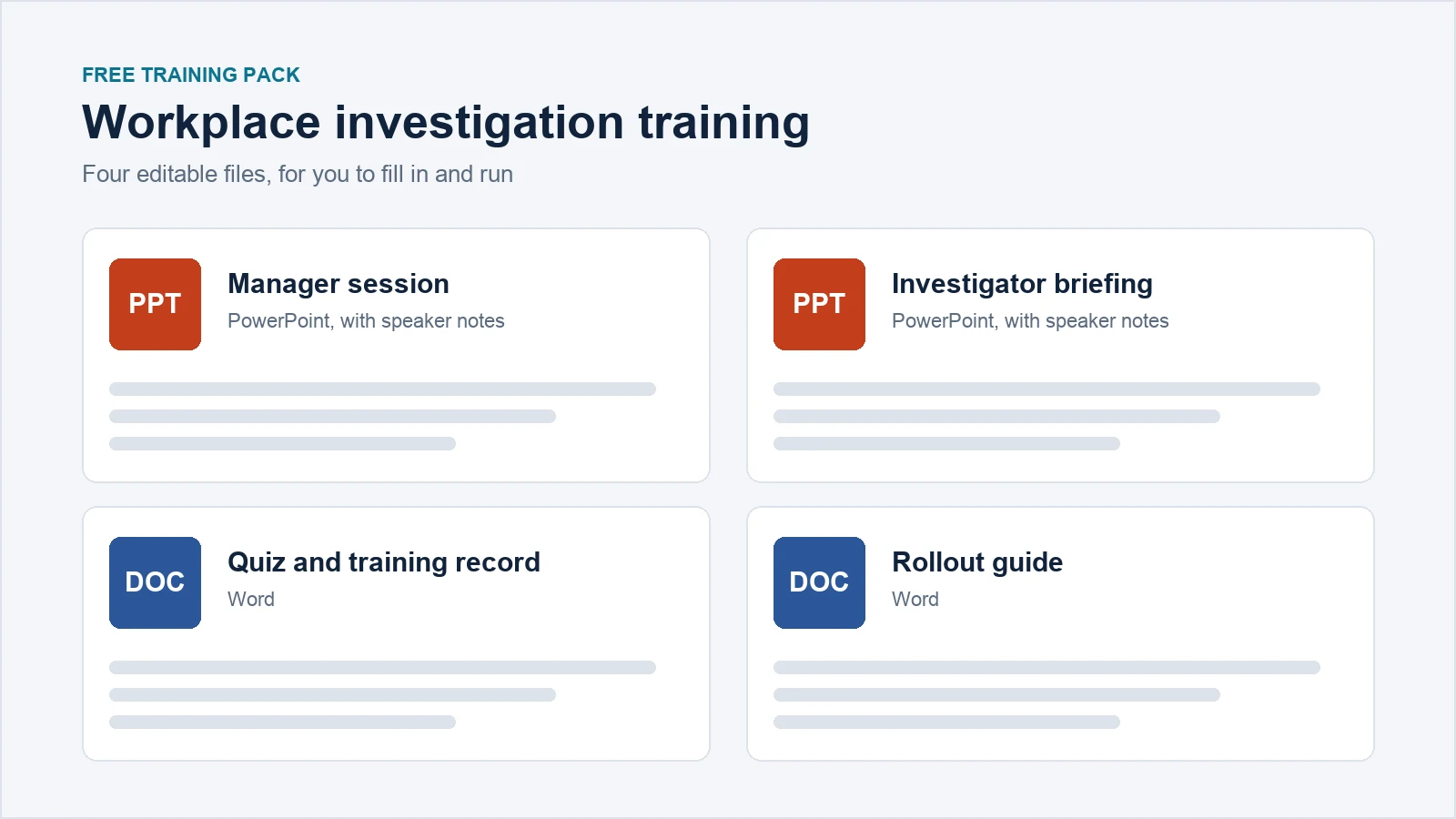
- Manager session. PowerPoint, with speaker notes: handling a concern fairly, from the first conversation to any appeal.
- Investigator briefing. PowerPoint, with speaker notes, for the people who run investigations: planning, interviews, evidence and writing up.
- Quiz and training record. Word: questions with an answer sheet for the presenter, and a training record for everyone to sign.
- Rollout guide. Word: how to tailor, deliver, record, refresh and check the training.
You fill in the gaps for your organisation, present the sessions and keep your own records. It doesn’t include a certificate of completion.
Request received
Thanks. The team will send the four files to your inbox within one working day.
Could not send that request
Something went wrong on our side. Please try again, or use our contact form and our team will send you the pack.
The tailored training, part by part
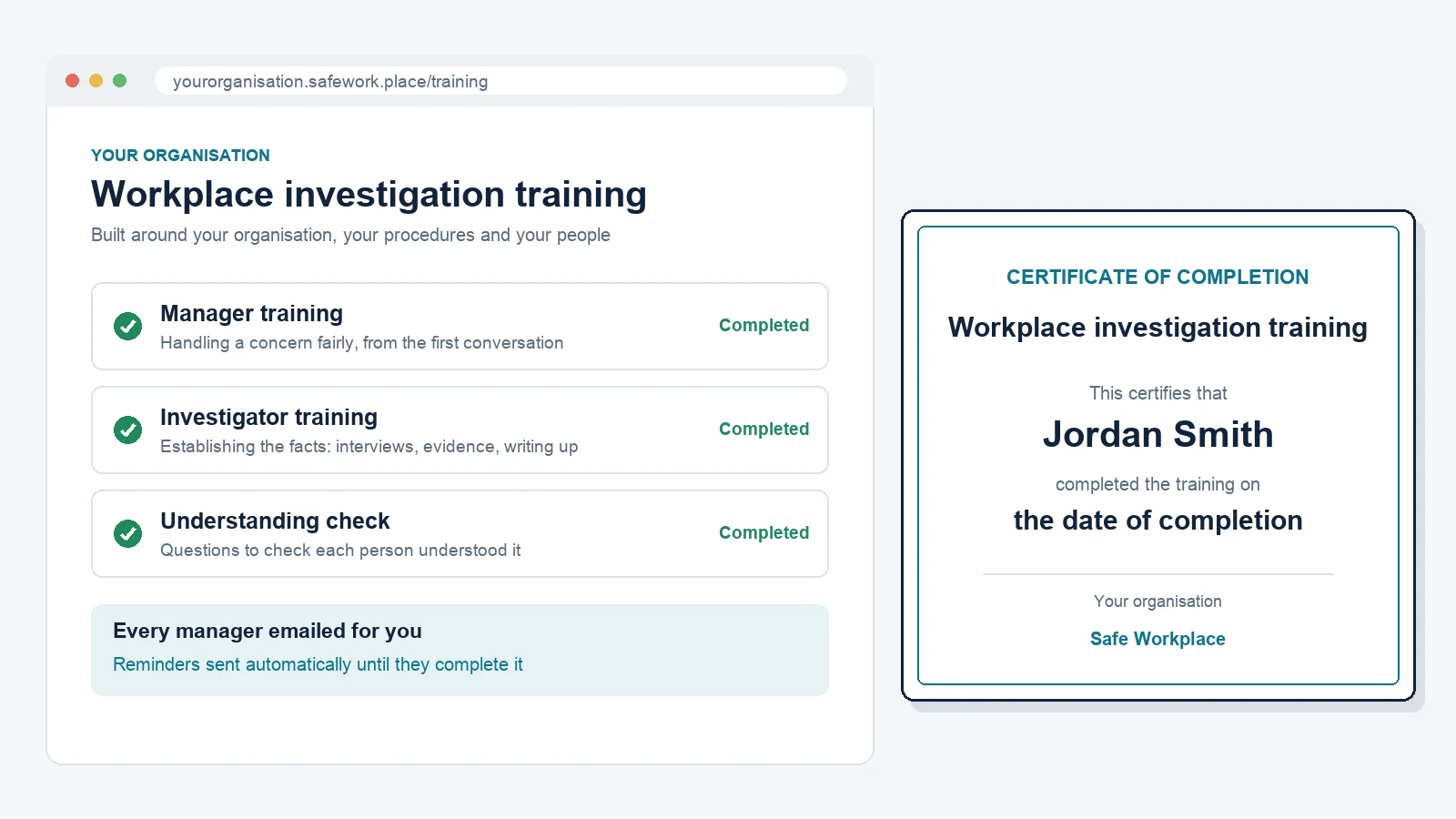
- Tailored to your organisation. We tailor the training content to your organisation, its processes and likely scenarios, with distinct manager and investigator training.
- A branded company site, or your own learning hub. Your training content in audio and video, with an understanding check, ready for everyone you invite to complete; or in a format to upload into your own learning or training hub.
- Distribution taken care of. Invite the people who need it, and each person gets an email to complete the training.
- Reminders and chases, automated. We remind anyone who hasn’t finished until they complete it.
- A certificate for every completion. A dated certificate for each person who completes it, to save for your records.
Our team will be in touch with follow-up questions to tailor the content to your organisation.
Request received
Thanks. Our team will be in touch within one working day with follow-up questions to tailor the training to your organisation.
Could not send that request
Something went wrong on our side. Please try again, or use our contact form and our team will be in touch.
What the training covers
Manager session:
- When a concern needs a formal investigation, and when a quiet word will do
- Your disciplinary and grievance procedures, and where to find them
- A fair process, step by step: establish the facts, tell the employee, meet, decide, hear any appeal
- Who does what: different people to investigate, hear the case and hear any appeal
- Suspension: only when it's necessary, kept brief and under review
- The right to be accompanied, and when it applies
- Why it matters more from 1 January 2027: unfair dismissal claims after 6 months' service
- Keeping a written record of every case
Investigator briefing:
- Your role: establishing the facts of the case
- Planning the investigation: the allegation, the evidence and the witnesses
- Moving without unreasonable delay
- Investigatory meetings with the employee
- Interviewing witnesses and taking statements
- Investigating a grievance
- Writing up what you found for the manager who hears the case
- Keeping it confidential, consistent and fair
After the training
Name who can investigate. Train enough managers that, where practicable, one can investigate, another can hear the case, and a third, not involved before, can hear any appeal.
Keep a written record of every case, from the first concern to the outcome of any appeal.
Keep your procedures easy to find. Managers need to know where your disciplinary and grievance procedures are and how to use them, so update the training when the procedures change.
Our free bullying and harassment and GDPR training packs work the same way.
Common questions
Is workplace investigation training a legal requirement?
No law names it. The Acas Code of Practice, which employment tribunals take into account, says employers should help managers understand the rules and procedures, where to find them and how to use them.
What changes on 1 January 2027?
Employees can claim unfair dismissal after 6 months' service, down from 2 years, and the cap on the compensatory award goes. The new rules apply to any dismissal whose effective date of termination falls on or after 1 January 2027, even if you gave notice before.
Can the same manager investigate and hear the disciplinary?
The Acas Code says that in misconduct cases, where practicable, different people should carry out the investigation and the disciplinary hearing. An appeal should go, wherever possible, to a manager who hasn't been involved in the case.
Does an employee have the right to be accompanied at an investigation meeting?
Not by law: the Acas Code says there's no statutory right to be accompanied at a formal investigatory meeting, and your own procedure may allow it. The statutory right applies at disciplinary meetings that could lead to a formal warning or other disciplinary action, and at appeal hearings.
Should we suspend someone during an investigation?
Only where it's necessary. The Acas Code says to keep paid suspension as brief as possible, review it as you go, and make clear to the employee that it isn't a disciplinary action.
How long should a workplace investigation take?
The Acas Code sets no time limit. It asks employers to investigate without unreasonable delay, and not to unreasonably delay meetings, decisions or the confirmation of those decisions.
Does the training cover grievance investigations?
Yes. The investigator briefing covers investigating a grievance, and the Acas Code suggests adjourning a grievance meeting when you need to investigate further.
What's in the free workplace investigation training pack?
Four editable files: a manager session (PowerPoint, with speaker notes), an investigator briefing (PowerPoint, with speaker notes), a quiz with answers and a training record to sign (Word), and a rollout guide (Word).
What's the difference between the free pack and the tailored training?
The free pack is the template: four editable files you fill in, present and record yourself, with no certificate of completion. We build the tailored training for your organisation and run it for you: a branded company site with your training content, everyone you invite emailed and reminded until they complete it, and a dated certificate for every completion.
References
- Acas: Code of Practice on disciplinary and grievance procedures
- Employment Rights Act 2025, section 25: unfair dismissal, qualifying period and compensation
- Employment Rights Act 2025 (Commencement No. 4 and Transitional and Saving Provisions) Regulations 2026 (SI 2026/559)
- GOV.UK: Plan to Make Work Pay and Employment Rights Act timeline update
General information, not legal advice. It reflects our understanding of the law and official guidance as of October 2026, so check the sources above for the current position.