
Manual handling training: a free pack for your staff and managers
A staff session, a manager briefing, a quiz with a training record, and a rollout guide, built on the Manual Handling Operations Regulations and HSE guidance for employers in England, Wales and Scotland, and free by email. Or have us tailor it and run it for you, on a branded company site, £24.99 per employee.
Every employer must avoid manual handling that risks injury where it reasonably can, assess and reduce the risk of the handling that remains, and train staff when they start and whenever their risks change.
Take the free pack and run it yourself, or have us tailor it and run it for you: a branded company site with your training content, every member of staff invited and reminded by email, and a certificate for every completion, £24.99 per employee. Neither replaces practical, hands-on training with a trainer, which stays in person.
| Question | Short answer |
|---|---|
| Is training required? | Yes. Employers must give adequate health and safety training, and must weigh each person’s knowledge and training when judging the risk of a task. |
| Who needs it? | Staff whose work involves manual handling, when they start and whenever their risks change. |
| What should it cover? | Risk factors and how injuries happen, mechanical aids, good handling technique, the systems of work for each task, and practical work with a trainer. |
| How often? | No fixed interval: repeated where appropriate, and whenever risks change. |
| What else must you do? | Avoid risky handling where you reasonably can, assess and reduce the rest, and tell staff about the loads they handle. |
What the law expects of your training
Every employer must give staff the information, instruction, training and supervision needed to keep them healthy and safe at work, so far as is reasonably practicable (Health and Safety at Work etc. Act 1974, section 2). For handling loads, regulation 4 of the Manual Handling Operations Regulations 1992 says each employer must:
- Avoid handling that risks injury, so far as is reasonably practicable.
- Assess the handling it can’t reasonably avoid, with a suitable and sufficient assessment of each task.
- Reduce the risk of injury to the lowest level reasonably practicable.
- Tell staff about each load: general indications and, where reasonably practicable, precise information on its weight, and on its heavier side when its centre of gravity is off-centre.
- Review the assessment when there’s reason to suspect it’s no longer valid, or the handling has changed significantly.
When it judges the risk of a task and the steps to reduce it, the employer must weigh each person’s physical suitability, their clothing and footwear, their knowledge and training, the findings of its general risk assessment, whether they belong to a group identified as especially at risk, and any health surveillance results.
Regulation 13 of the Management of Health and Safety at Work Regulations 1999 sets when the training happens. It must:
- Start when people join, and come again when they face new or increased risks: a transfer or new responsibilities, new or changed equipment, new technology, or a new or changed system of work.
- Happen again periodically where appropriate, and change with new or changed risks.
- Take place during working hours.
HSE’s guidance says training should fit the work and cover manual handling risk factors and how injuries happen, mechanical aids, good handling technique, the systems of work for each person’s tasks, and practical work, so the trainer can spot anything a person isn’t doing safely and put it right. Training on its own won’t make the work safe: design each task to be as safe as reasonably practicable first, then check people understand and apply your procedures.
The free pack and the tailored training cover the theory and the manager’s part. Neither replaces that practical work, which stays in person. The regulations cover England, Wales and Scotland.
What you’ll get
Run the free pack yourself, or have us tailor it to your organisation and run it for you.
| Free pack | Tailored and run for you, £24.99 per employee | |
|---|---|---|
| The content | Complete the general training template | Tailored to your organisation for you |
| How staff complete it | Staff and manager slides with speaker notes, a quiz and a rollout guide, to deliver however suits you | A branded company site with your training content loaded for all staff to complete |
| Getting it to staff | You organise it | Every member of staff emailed for you |
| Reminders and chases | No automation included | Reminders and chases automated for you |
| Certificate of completion | Not included | A dated certificate for every person who completes it |
| Format | PowerPoint slides and Word documents | Audio and video, or a format to upload into your own learning or training hub |
| Managers and employees | A staff session and a manager briefing | Distinct manager and employee training |
| Cost | Free | £24.99 per employee |
The free pack, file by file
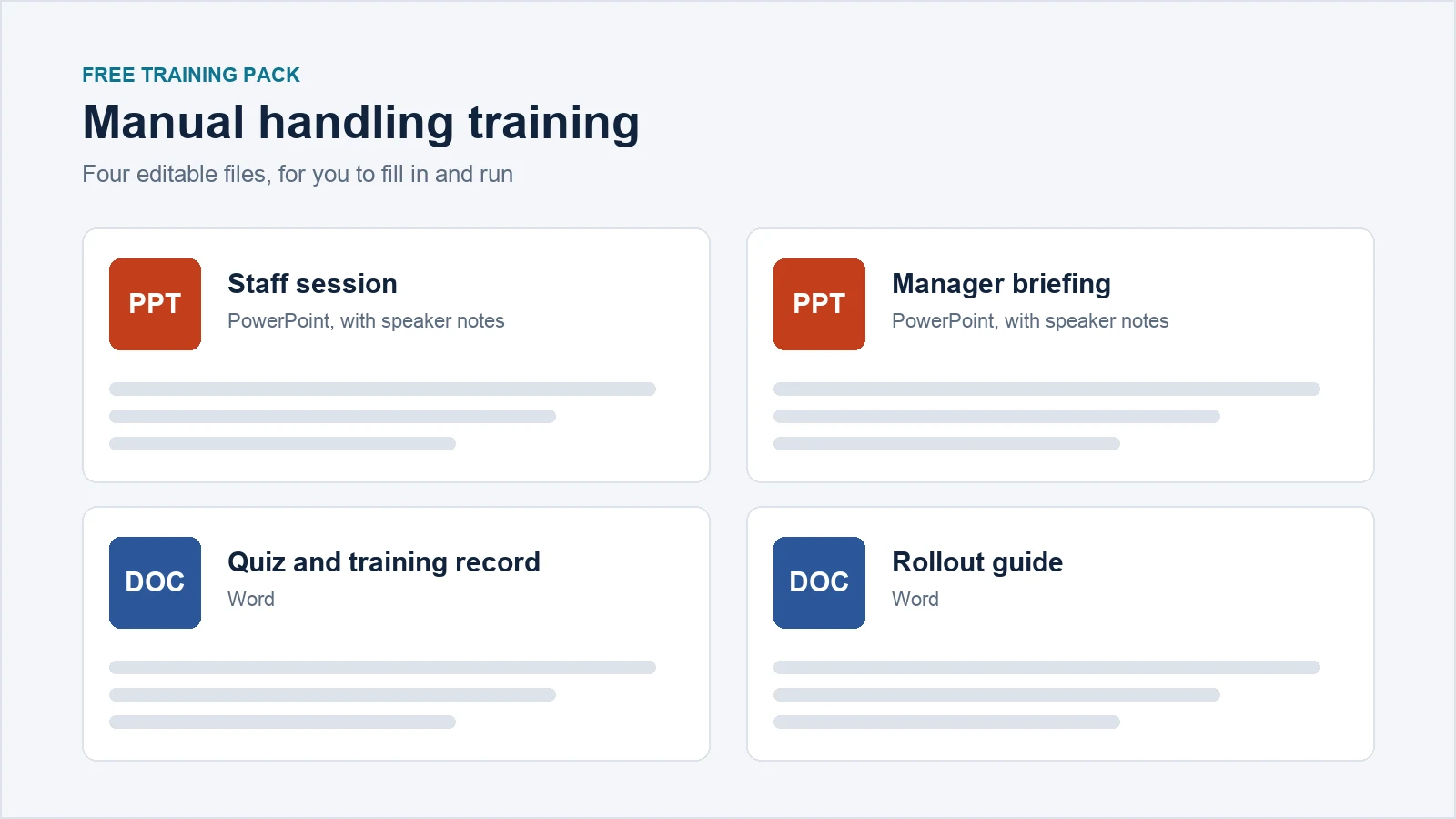
- Staff session. PowerPoint, with speaker notes: how manual handling injuries happen, and how to handle loads safely.
- Manager briefing. PowerPoint, with speaker notes, for the managers who assess handling tasks and reduce the risk.
- Quiz and training record. Word: questions with an answer sheet for the presenter, and a training record for everyone to sign.
- Rollout guide. Word: how to tailor, deliver, record, refresh and check the training.
You fill in the gaps for your tasks, present the sessions, run the hands-on practice and keep your own records. It doesn’t include a certificate of completion.
Request received
Thanks. The team will send the four files to your inbox within one working day.
Could not send that request
Something went wrong on our side. Please try again, or use our contact form and our team will send you the pack.
The tailored training, part by part
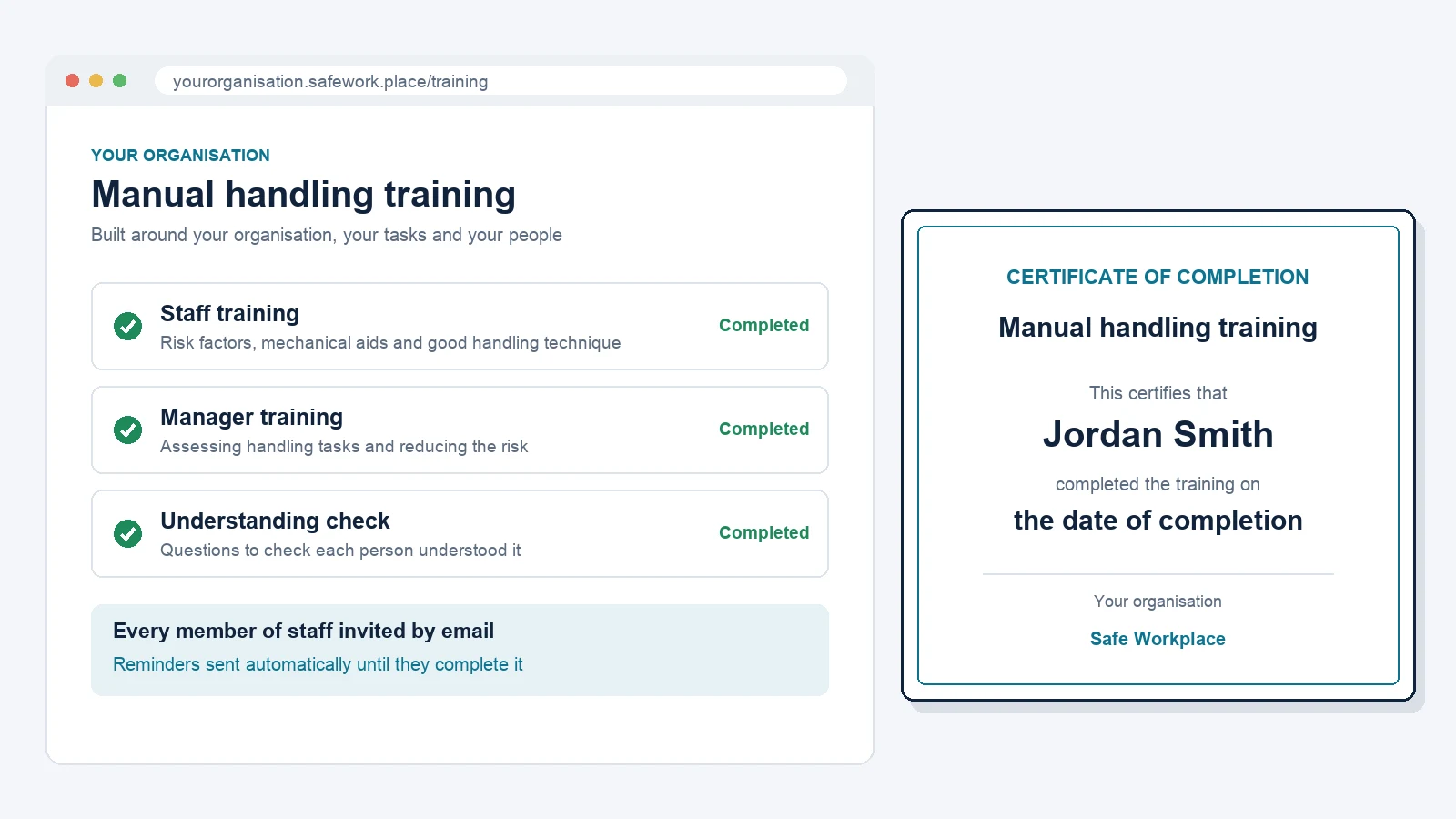
- Tailored to your organisation. We tailor the training content to your organisation, its processes and likely scenarios, with distinct manager and employee training.
- A branded company site, or your own learning hub. Your training content in audio and video, with an understanding check, ready for all your staff to complete; or in a format to upload into your own learning or training hub.
- Distribution taken care of. Invite all your staff, and each person gets an email to complete the training.
- Reminders and chases, automated. We remind anyone who hasn’t finished until they complete it.
- A certificate for every completion. A dated certificate for each person who completes it, to save for your records.
Our team will be in touch with follow-up questions to tailor the content to your organisation.
Request received
Thanks. Our team will be in touch within one working day with follow-up questions to tailor the training to your organisation.
Could not send that request
Something went wrong on our side. Please try again, or use our contact form and our team will be in touch.
What the training covers
Staff session:
- How manual handling injuries happen, and the risk factors behind them
- Using mechanical aids to move loads
- Good handling technique
- The systems of work for your own tasks
- What you're told about a load's weight and its heavier side
- Clothing, footwear and fitness for a task
- What your hands-on practice will check
Manager briefing:
- Your duty: avoid, assess, reduce and inform
- Making a suitable and sufficient assessment of each manual handling task
- Reducing the risk of injury to the lowest level reasonably practicable
- Telling staff the weight of a load and its heavier side
- The person: physical suitability, clothing, knowledge and training, and anyone especially at risk
- When to review an assessment
- Arranging hands-on practice, and checking people apply what they learned
After the training
Run the hands-on practice. Have a trainer watch each person carry out their own handling tasks and put right anything they aren’t doing safely.
Check people apply it. Monitor and review your procedures to make sure staff understand them and use them.
Train again when things change. A new role, new equipment, new technology or a new way of working means new training for the people it affects.
Update the training when your assessments change. Review a manual handling assessment when you suspect it’s no longer valid or the handling changes significantly, and update the training with it.
Our free fire safety and COSHH training packs work the same way.
Common questions
Is manual handling training a legal requirement?
Yes. Under regulation 13 of the Management of Health and Safety at Work Regulations 1999, employers must give staff adequate health and safety training when they start and when they face new or increased risks. The Manual Handling Operations Regulations 1992 also make each person's knowledge and training part of judging the risk of a task and the steps to reduce it.
How often should staff do manual handling training?
Regulation 13 of the Management of Health and Safety at Work Regulations 1999 sets no fixed interval. It says you must repeat training periodically where appropriate, adapt it to new or changed risks, and train people again when they face new or increased risks: a new role, new equipment, new technology or a new way of working.
Can staff do manual handling training online?
The theory can. HSE says training should include practical work, so the trainer can spot anything a person isn't doing safely and put it right. Neither the free pack nor the tailored training replaces that hands-on practice: run it in person, on the tasks your staff carry out.
What should manual handling training cover?
HSE says it should fit the work people do and cover the risk factors and how injuries happen, how to use mechanical aids, good handling technique, the systems of work for each person's tasks, and practical work with a trainer.
Does the training cover moving and handling people?
The free pack covers manual handling in general. We build the tailored training around your organisation's tasks, so a care provider's version covers how its staff move and handle people. In both, the hands-on practice stays in person with a trainer.
Does the training come with a manual handling certificate?
The free pack doesn't include a certificate of completion: it has a training record for everyone to sign. The tailored training gives every person who completes it a dated certificate.
What's in the free manual handling training pack?
Four editable files: a staff session (PowerPoint, with speaker notes), a manager briefing (PowerPoint, with speaker notes), a quiz with answers and a training record to sign (Word), and a rollout guide (Word).
What's the difference between the free pack and the tailored training?
The free pack is the template: four editable files you fill in, present and record yourself, with no certificate of completion. We build the tailored training for your organisation and run it for you: a branded company site with your training content, every member of staff invited by email and reminded until they complete it, and a dated certificate for every completion.
References
- Manual Handling Operations Regulations 1992, regulation 4: duties of employers
- HSE: Manual handling at work, training
- Management of Health and Safety at Work Regulations 1999, regulation 13: capabilities and training
- Health and Safety at Work etc. Act 1974, section 2: general duties of employers to their employees
General information, not legal advice. It reflects our understanding of the law and official guidance as of October 2026, so check the sources above for the current position.