
More cases. More scrutiny. More expectations from leadership, legal, and employees alike. These are the pressures modern ER and HR teams face.
HR Acuity is one of the most established names in employee relations case management. It's well-regarded, purpose-built for ER teams, and has a strong footprint in large enterprises.
But it isn't the right fit for every organisation, and plenty of teams evaluating it end up looking for something different. In fact, many teams start to realise that tracking cases isn’t the same as managing risk, and that closing cases isn’t the same as proving fair outcomes.
That’s why more organisations are actively exploring HRAcuity alternatives, not because it’s a bad product, but because their needs have evolved.
Maybe the pricing doesn't fit your budget. Maybe you need a platform that connects ER case management to the wider governance picture, like cases, whistleblowing, risks, audits, and policies, rather than managing it in isolation. Maybe you're in a regulated industry where HR Acuity's US-enterprise DNA doesn't map to your compliance obligations.
Whatever the reason, this article gives you a thorough, honest look at the best alternatives, what each platform does, who it's built for, and where it falls short.
What to look for in an HR Acuity alternative
Before diving in, it's worth being clear on what actually matters when evaluating ER case management software:
Structured investigation workflows: Not just a place to log cases, but a guided process that produces consistent, defensible outcomes regardless of who conducts the investigation.
Automated escalation and task management: Owners assigned, deadlines set, and the right people notified automatically. Manual chasing is where cases stall, and outcomes get inconsistent.
Pattern and trend detection: The ability to spot recurring themes across cases, departments, and time periods before they become an employment tribunal, a grievance cluster, or a board-level concern.
Evidence and audit trail: Every action, decision, and outcome documented and exportable, so you can demonstrate what happened, how it was handled, and what changed as a result.
Speak-up and disclosure routes: Multiple channels for employees to raise concerns, with anonymity protected and every submission automatically routed into a structured workflow.
Connection to policy and learning: When a case reveals a policy gap or a training need, that thread should be traceable and evidenced — not lost in an email chain.
With that in mind, here are the ten best HR Acuity alternatives.
The 10 best ER case management software providers
1. Safe Workplace: Best for ER teams that need case management connected to the full governance picture
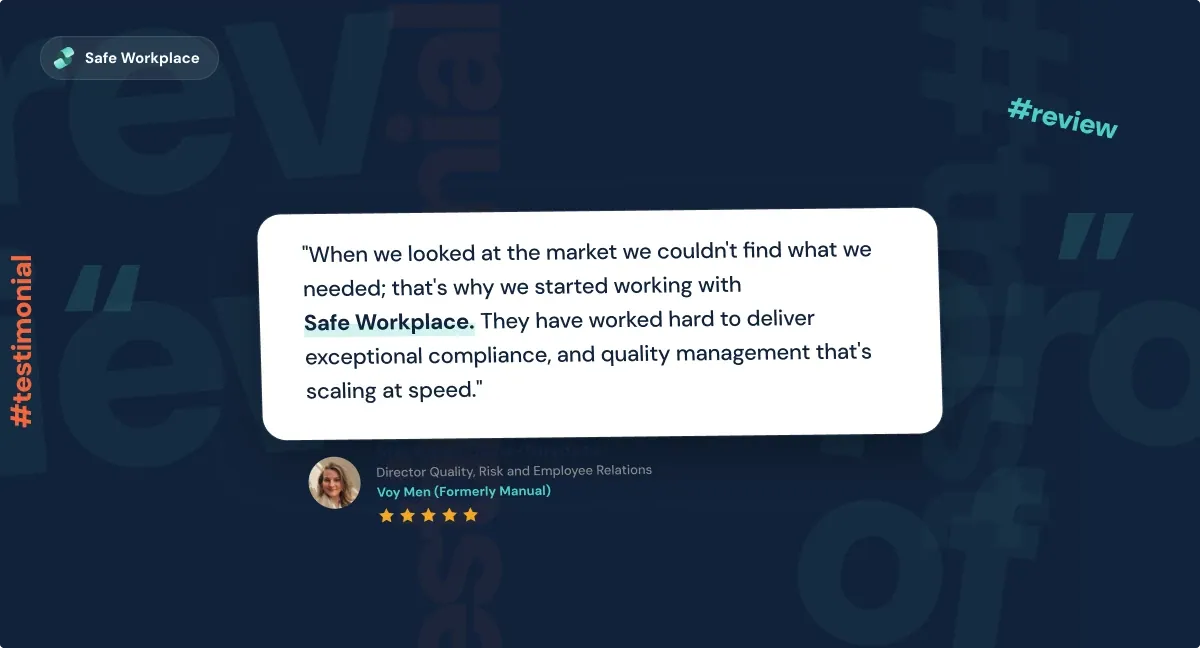
Safe Workplace built its reputation in regulated healthcare, trusted by Voy Men (formerly Manual), PillPack, and so much more, where the cost of poor governance is measured in patient safety, regulatory sanctions, and CQC ratings.
That heritage means the platform was designed from day one around evidence, accountability, and the kind of structured investigation workflows that hold up under regulatory scrutiny.
But the problems Safe Workplace was built to solve; inconsistent investigations, cases that don't lead to learning, no way to prove what changed, aren't unique to healthcare. They're the same problems facing ER and HR professionals across financial services, pharma, professional services, public sector, and any organisation where getting a case wrong has real consequences.
Safe Workplace is a fully integrated governance platform built around a single idea: that ER cases, risks, policies, and learning shouldn't live in separate systems.
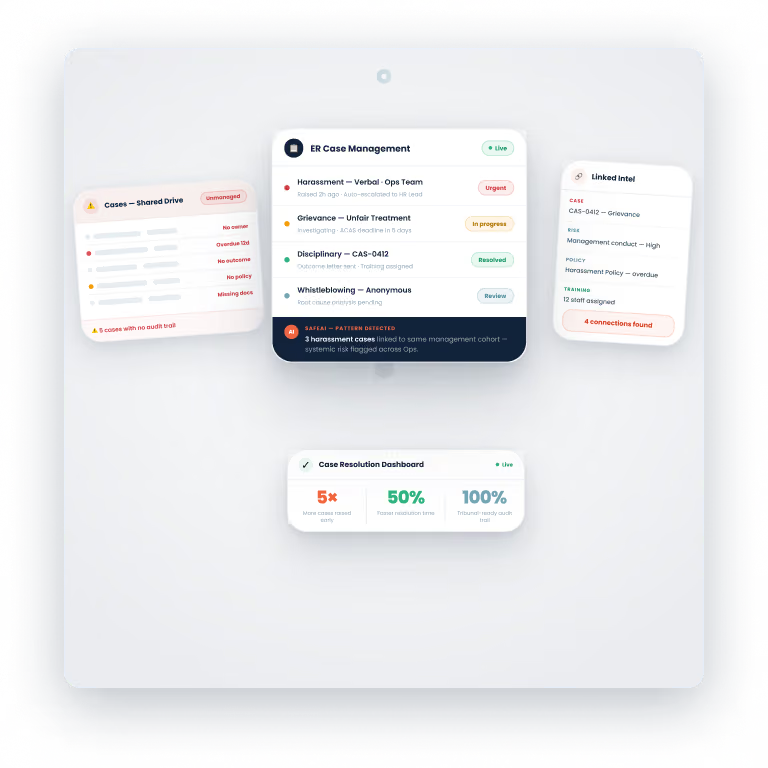
Everything connects and those connections are surfaced automatically through a feature called Linked Intel, which shows you how a case links to a policy gap, a risk, and a training need, all in one place. Where most ER platforms stop at case management, Safe Workplace closes the loop across the whole governance function.
What Safe Workplace does
ER Case Management: Every case follows a structured investigation workflow from intake through to resolution. Tasks are auto-assigned based on case type, deadlines are applied automatically, and case owners are notified before breaches — not after. Grievances, disciplinaries, performance cases, harassment complaints, and whistleblowing concerns are all handled through consistent, repeatable workflows that produce defensible outcomes every time.
Automated escalation: Define once which case types trigger which escalations. Serious misconduct alerts the right leader. Safeguarding concerns route to the named officer. Whistleblowing disclosures follow the correct disclosure pathway. Nothing waits for a meeting or a forwarded email to move forward.
Speak-up and whistleblowing channels: Employees can raise concerns through a mobile app, a web form, WhatsApp, a QR code, email, or a hotline. Every submission is timestamped, anonymised where required, and automatically routed into the same structured case workflow. Anonymous reporting is supported across all channels.
Linked Intel: Safe Workplace's defining capability. Every case is automatically checked against your risk register, policy framework, and learning records. When connections exist, a harassment case linked to a pattern of complaints from the same management team, a grievance linked to an unacknowledged or outdated policy, a disciplinary case linked to a training gap that was never addressed — they're surfaced in one place. You can trace root causes, evidence learning, and demonstrate to leadership or a regulator that governance is working.
SafeAI - pattern detection and case quality scoring: SafeAI analyses patterns across your case portfolio continuously. If multiple grievances from the same department share a common management factor, it flags it. If a case type keeps appearing alongside a recurring policy gap, it surfaces the systemic theme. It also scores case quality, flags procedural bias risk, and generates AI-assisted case summaries, so investigations are consistent, not dependent on who conducts them.
Case-to-learning workflow: When an investigation identifies a knowledge gap or conduct issue that needs addressing through training, a targeted learning module can be created directly from within the case workflow, assigned to specific staff, and linked back to the original case as evidence. That thread — what happened, what we learned, how we addressed it, proof that staff completed it — is what you need when a case is challenged or when leadership asks what changed.
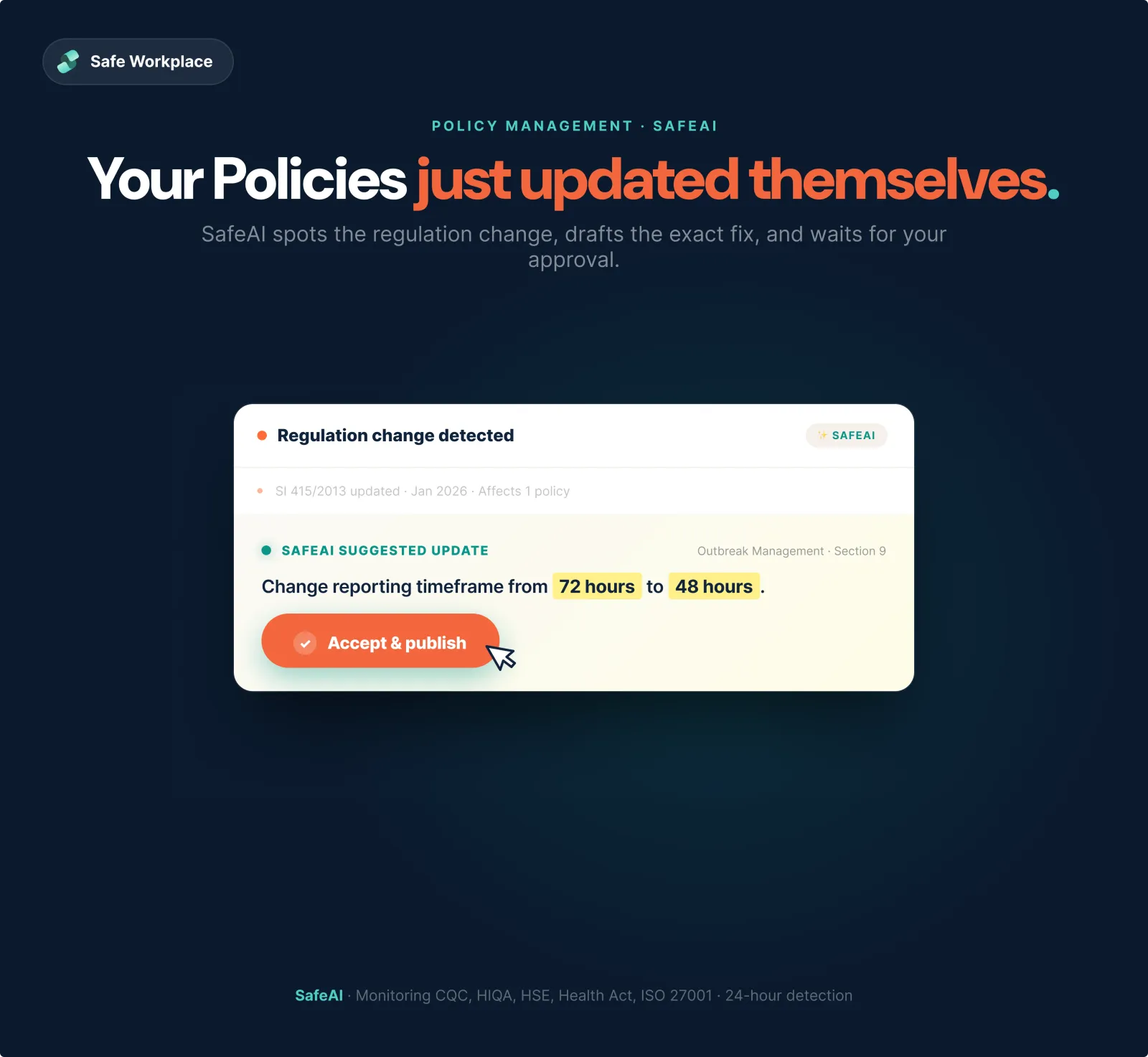
Policy management: SafeAI scans your policies against current obligations and flags gaps before your next review cycle. Policy updates cascade automatically to staff, with acknowledgement tracking and a full audit trail — so you can always demonstrate who read what, and when.
Tribunal-ready documentation: Every action, decision, and outcome is logged in a complete, exportable audit trail. If a case goes to employment tribunal or regulatory review, everything is structured, timestamped, and ready ,not assembled the night before from emails and spreadsheets.
Who it's best for
ER and HR professionals in regulated, compliance-driven organisations who need case management that connects to the wider governance picture, not just a place to log cases.
Particularly strong for organisations where a case outcome needs to be evidenced to leadership, a regulator, or a tribunal, and for teams where the same issues keep recurring because there's no structured way to close the loop between a case, a policy, and learning.
Pros
Structured investigation workflows that produce consistent, defensible outcomes regardless of the investigator
SafeAI surfaces patterns across the case portfolio, scores quality, and flags procedural bias risk
Automated task assignment, escalation, and deadline tracking — cases don't stall
Linked Intel connects cases to policy gaps, risks, and learning needs automatically
Case-to-learning workflow creates a complete, evidence-based thread from concern to outcome
Speak-up and whistleblowing channels across mobile, web, WhatsApp, QR code, and hotline
Full audit trail — tribunal-ready documentation at any moment
AI-powered policy gap detection and acknowledgement tracking
Trusted by Bupa, HCA Healthcare, Roche, Amazon, Nuffield Health, and Spire Healthcare
Transparent pricing from £500/month per module
Fast, lean onboarding — not a 12-month enterprise implementation
Cons
If you only need standalone case management with no interest in connecting it to policy, risk, or learning governance, the platform's breadth won't be fully utilised, Safe Workplace's real value is in the connections
Built with regulated industry rigour, which means some organisations in less complex environments may find it more structured than they need
Best for: ER and HR teams in regulated, compliance-driven organisations, financial services, pharma, healthcare, professional services, public sector, where case outcomes need to be consistently evidenced and governance needs to close the loop.
2. Dovetail Software
Dovetail is a well-established HR case management and service delivery platform, ranked number one for vendor satisfaction and user experience in the Sapient Insights HR Systems Survey for five consecutive years.
It covers HR case management, employee relations, employee portal, knowledge management, and reporting.
Dovetail's strength is its breadth as an HR service delivery tool. It handles general HR enquiries, benefits queries, ER cases, and more, all in a single system accessible to both HR teams and employees. Its long-standing Workday partnership is a meaningful differentiator for organisations already running that stack.
Who it's best for
Mid-to-large organisations with a mature HR shared services model that need one platform for all employee-HR interactions, not just ER cases.
Pros
Consistently rated number one for ease of use and satisfaction in independent surveys
Strong knowledge base and employee self-service portal
Excellent Workday integration, longest-running Workday partner for HR case management
50+ pre-built reports and real-time analytics dashboards
Handles both general HR enquiries and ER cases in one system
Cons
More focused on HR service delivery than deep ER investigation workflows — less specialised than dedicated ER tools
No built-in policy management, learning governance, or risk connectivity
Interface noted by some reviewers as showing its age compared to newer platforms
Not built with the investigation rigour needed for complex, regulated ER environments
3. AllVoices
AllVoices positions itself as the only AI-native employee relations platform, covering case management, investigations, anonymous speak-up, performance issues, accommodation requests, and exit interviews. It's known for its clean interface, ease of use, and strong AI capabilities for case intake and summary generation.
Who it's best for
Tech and mid-market organisations that want an easy-to-adopt, AI-powered ER platform with strong anonymous speak-up capability and a clean user experience.
Pros
AI-native: automates case intake, generates summaries, surfaces relevant policy and precedent
Strong anonymous speak-up with multi-channel submission
Very intuitive, fast setup and high adoption rates
Covers the full ER case lifecycle from concern raised to resolution
Cons
Reporting capabilities noted by users as limited, often requires export to Excel or Tableau for deeper analysis
AI transparency is limited, users report minimal visibility into how AI outputs are generated, which creates problems for defensible decision-making
Can become a constraint as investigation complexity grows — less suited to regulated, high-stakes ER environments
No built-in policy governance or learning connectivity
4. NAVEX (EthicsPoint)
NAVEX One, which includes EthicsPoint, is a comprehensive governance, risk, and compliance platform trusted by over 15,000 organisations worldwide. EthicsPoint is widely regarded as the gold standard ethics and compliance hotline, with multi-language support, multiple intake channels, and robust case management workflows.
It's a genuine GRC platform, covering policy management, training, third-party screening, IT risk, and incident management in addition to ER case management. For large enterprises with complex compliance programmes across multiple jurisdictions, it has considerable depth.
Fun fact: Navex can be used alongside Safe Workplace -> Book a demo
Who it's best for
Large global enterprises that need a comprehensive GRC platform anchored by a class-leading ethics hotline, particularly where multinational regulatory compliance and whistleblowing obligations are the priority.
Pros
Industry-leading ethics hotline with 24/7 intake, multi-language support, and robust anonymity
Comprehensive GRC platform covering policy, training, third-party risk, and compliance management
Strong regulatory expertise for multinational compliance programmes
Extensive compliance training content library
Cons
Customer support rated poorly by a significant proportion of reviewers — described as slow and rigid
Pricing has been reports to be quite high per month and can be substantially higher for enterprise configurations
Limited integrations - implementing often requires reworking parts of your existing tech stack
Customisation is constrained - only two custom fields per template in some configurations
Complex to navigate for teams that primarily need ER case management rather than full GRC
5. Mitratech
Mitratech is a compliance and ethics platform with a strong focus on misconduct prevention, anonymous speak-up, and investigations. It offers ethics hotlines, 100% anonymous reporting, case management, and an extensive library of compliance training covering harassment, employment law, diversity, and workplace safety.
Its open API makes it reasonably integrable with existing HR stacks, and its training content is particularly strong for organisations that need to run regular compliance training programmes alongside case management.
Who it's best for
Mid-to-large organisations with a strong ethics and compliance focus, particularly those that need robust anonymous speak-up capability and a comprehensive training content library.
Pros
100% anonymous reporting with secure, confidential two-way communication between reporters and investigators
Extensive, regularly updated compliance training courses
Good API for integration with existing systems
Well-regarded for its ethics hotline and misconduct prevention capability
Cons
Case management functionality is less mature than purpose-built ER platforms
Better positioned as an ethics reporting and training tool than a full ER workflow system
No built-in policy governance or case-to-learning connectivity
Pricing is enterprise-tier and not publicly available
6. Case IQ
Case IQ (formerly i-Sight) is a well-established case management platform covering HR investigations, fraud, compliance, and workplace misconduct. It offers multi-channel case intake, AI-driven triage, configurable workflows, and strong analytics — making it a versatile choice for organisations that manage a broad range of investigation types across HR, legal, and compliance functions.
Who it's best for
Organisations that need a single investigation management platform across HR, fraud, compliance, and other case types — particularly where investigation workflows are complex and varied.
Pros
Highly configurable workflows suitable for a wide range of case and investigation types
Strong multi-channel intake options
Good analytics and cross-functional case reporting
AI-assisted triage for prioritising incoming cases
Cons
A broader focus means it isn't as deeply specialised for employee relations as purpose-built ER platforms
Can feel overly complex for teams that primarily need straightforward ER case management
No built-in policy management, learning governance, or speak-up channel infrastructure
Pricing is custom and not publicly disclosed
7. Workpro
Workpro is a UK-based case management platform founded in 2009, with a strong presence in the UK public sector, financial services, government, blue light, and housing organisations. It covers HR case management and employee relations with a particular strength in complaints management and regulatory casework.
It's one of the few platforms on this list available as both SaaS and on-premise, which matters for some public sector and highly regulated organisations with strict data residency requirements.
Who it's best for
UK-based organisations particularly in public sector, financial services, and housing — that need a reliable, compliant, on-premise-capable ER case management tool with strong process consistency.
Pros
Available as on-premise or SaaS, one of the few platforms offering this choice
Strong UK public sector and regulated industry track record
ISO 27001 accredited, UK-based data centres with double-encrypted backups
Good complaints and ER case management capability in one system
Workpro Connect module gives line managers self-service case access
Cons
AI capabilities are limited compared to newer platforms
Individual user-level customisation is restricted — changes require system administrator involvement
Interface is functional but dated compared to newer tools
No pattern detection, policy governance connectivity, or case-to-learning workflows
8. ServiceNow HR Service Delivery
ServiceNow's HR Service Delivery module is part of its broader enterprise platform suite. For organisations already running ServiceNow for IT service management, it offers a path to consolidating employee services, HR case management, document management, and self-service portal, within the same ecosystem.
It's not a purpose-built ER tool, but for large enterprises that prioritise platform consolidation and already have a ServiceNow footprint, it removes the need for a separate standalone system.
Who it's best for
Large enterprises with existing ServiceNow investment that want to consolidate HR and IT service management into a single platform.
Pros
Strong platform consolidation for ServiceNow-native organisations
Personalised dashboards and solid workflow analytics
Generative AI tools for automating repetitive tasks and generating case summaries
Well-developed integrations within the ServiceNow ecosystem
Cons
Designed by an IT-focused organisation and adapted for HR, investigation workflows and ER-specific functionality reflect this
Complex to configure for specialist ER use cases
No built-in ethics hotline, speak-up infrastructure, or policy governance connectivity
Expensive as a standalone ER tool if you're not already running ServiceNow
9. Neocase
Neocase is a cloud-based HR service delivery platform designed for large HR shared services functions, with strong capabilities across ER case management, employee self-service, workflow automation, and knowledge management. It integrates deeply with Workday, SAP, and other major HRIS systems, and supports multi-language and multi-region deployments.
Who it's best for
Large enterprises with complex HR shared services operations across multiple regions and languages, particularly those running Workday or SAP as their core HRIS.
Pros
Handles ER case management alongside full HR shared services in one platform
Strong HRIS integrations, Workday, SAP, SuccessFactors
Multi-language, multi-region support with local compliance configuration
Employee self-service portal with AI-powered knowledge base
Cons
Not purpose-built for ER, lacks the investigation depth and speak-up infrastructure of specialist platforms
Not well-suited to smaller organisations with fewer than 500 employees
Investigation templates are less intensive than specialist ER tools
Significant configuration required to unlock full ER functionality
10. Workday HCM
Workday doesn't position itself as a standalone ER tool, but for organisations already running Workday HCM, its ER and case management capabilities have developed meaningfully. With native integration across payroll, people data, and workforce management, it removes the need to transfer data between systems and gives HR leaders a single view of the employee.
Who it's best for
Large organisations already fully committed to the Workday ecosystem that want ER case management within their existing HCM investment rather than a separate specialist tool.
Pros
Native integration with Workday people data, payroll, and workforce management
Single system of record, no data sync or transfer required
Strong analytics when paired with Workday's broader reporting suite
Familiar interface for teams already running Workday daily
Cons
ER case management is significantly less specialised than purpose-built tools
Investigation workflows, speak-up infrastructure, and compliance functionality are less mature
Best suited only to existing Workday customers, not a platform to adopt for ER in isolation
No built-in policy governance or case-to-learning connectivity
Comparison at a glance
Platform | Best for | Speak-up / whistleblowing | Pattern detection | Policy + learning governance |
|---|---|---|---|---|
Safe Workplace | ER in regulated, compliance-driven organisations | ✓ Multi-channel | ✓ SafeAI | ✓ Full — cases, policy, learning connected |
HR Acuity | Large US enterprises — ER-specialist | ✓ | ✓ | ✗ |
Dovetail | HR shared services teams | ✗ | ✗ | ✗ |
AllVoices | Tech / mid-market, AI-native | ✓ | Limited | ✗ |
NAVEX EthicsPoint | Global enterprise GRC | ✓ | ✓ | ✓ Policy only |
Mitratech | Ethics and misconduct prevention | ✓ | ✗ | ✗ |
Case IQ | Multi-type investigation management | ✓ | Limited | ✗ |
Workpro | UK public sector and regulated organisations | ✗ | ✗ | ✗ |
ServiceNow | Existing ServiceNow organisations | ✗ | ✗ | ✗ |
Neocase | Global HR shared services | ✗ | ✗ | ✗ |
Workday HCM | Existing Workday organisations | ✗ | ✗ | ✗ |
Which alternative is right for you?
If you need the most purpose-built, ER-specialist platform with a strong US enterprise track record, HR Acuity remains worth evaluating alongside this list.
If you run a mature HR shared services function and need one platform for all employee-HR interactions, Dovetail or Neocase are worth a close look.
If you want AI-native ER management with a clean, fast-to-adopt interface, AllVoices is worth considering.
If you need a comprehensive ethics and GRC platform with a class-leading whistleblowing hotline, NAVEX One is the established leader.
If you're an ER or HR professional in a regulated, compliance-driven organisation, and you need case management that doesn't just log cases but connects them to policy, risk, and learning, so you can evidence fair, consistent outcomes at any moment, Safe Workplace was built for that.
The best way to understand the difference is to see it working.
Book a demo → we'll walk through your specific case types, investigation workflows, and how the platform helps you evidence outcomes. No generic walkthrough.
Prefer to explore on your own first? See the full platform in under 5 minutes →