
Information governance training: what the DSPT 2026-27 asks of your staff
For care homes, home care providers, pharmacies, and dental and GP practices on the NHS Data Security and Protection Toolkit: who has to train, what training counts, the training needs analysis, phishing and the evidence to keep. Get a free training needs analysis template, or tailored data security training with the phishing and scam readiness check included, £9.99 + VAT per employee.
The NHS Data Security and Protection Toolkit’s 2026-27 version asks care, pharmacy, dental and GP providers to have at least 95% of the people with access to personal data trained in data security and protection, and cyber security, in the last twelve months. Assessments for this version are due by 30 June 2027.
Plan the training with our free training needs analysis template, or have us tailor your data security training, with the phishing and scam readiness check included, £9.99 + VAT per employee.
| Question | Short answer |
|---|---|
| What does it ask? | At least 95% of staff, directors, trustees and volunteers with access to personal data trained in data security and protection, and cyber security, in the last twelve months |
| Who has to meet it? | Social care providers on the NHS Standard Contract, CQC market oversight providers, pharmacies, dentists, other providers and GP practices |
| By when? | 30 June 2027, for the 2026-27 version (version 9, published on 2 October 2026) |
| A training needs analysis? | Yes for care, pharmacy, dental and other providers, completed in the last twelve months; GP practices don’t answer this item |
| Phishing? | An optional monthly count of the phishing emails staff report; GP practices and organisations on NHSmail don’t answer it |
| NHS trusts? | A separate version, which checks that trusts track and refresh each person’s training, and that it changes how people behave |
Who has to meet the toolkit’s staff training rules
The Data Security and Protection Toolkit covers every organisation with access to NHS patients’ data or national NHS systems, and social care providers that provide care through the NHS Standard Contract. NHS England says not submitting can bring enforcement, including fines.
The 2026-27 workbook sorts organisations into categories, each with its own questions on staff training:
- Category 3: social care providers, CQC market oversight providers, pharmacies, dentists and other providers. They answer the 95% question and need a training needs analysis from the last twelve months.
- Category 4: GP practices. They answer the 95% question. The training needs analysis isn’t one of their items.
- Category 1: NHS trusts, integrated care boards and the other organisations in this category answer a separate, CAF-aligned version (see NHS trusts).
What training counts towards the 95%
Item 3.2.1 asks: “Have at least 95% of staff, directors, trustees and volunteers in your organisation completed training on data security and protection, and cyber security, in the last twelve months?”
- Appropriate training, at the level you set. The help text asks everyone with access to personal data to complete appropriate data security and protection, and cyber security, training every year, at the level your training needs analysis sets, using “a range of training and awareness methods to reach all staff effectively”.
- A free course for adult social care. The toolkit says Digital Care Hub’s free Data Security and Protection eLearning course “meets this requirement for staff working in adult social care”.
- The NHS course. NHS e-learning (e-LfH) runs its own course, Data Security Awareness.
- Directors, trustees and volunteers count. So does everyone else with access to personal data.
- Twelve months, counted back from publishing. A person counts only if they trained in the twelve months before you publish your assessment.
- Why the target is 95%. The toolkit accepts that illness, maternity or paternity leave, people leaving and other reasons can stop some people training each year.
For what UK GDPR and the ICO expect of staff training, see our GDPR training guide.
The training needs analysis: what it covers and who needs one
Item 3.1.1 asks category 3 providers: “Has a training needs analysis covering data security and protection, and cyber security, been completed in the last twelve months?” It’s mandatory for social care providers, CQC market oversight providers, pharmacies, dentists and other providers. GP practices don’t answer it.
The toolkit’s help text sets out what the analysis does:
- It sets the training for each group. It identifies the data security and protection, and cyber security, training needs across your organisation, and the level of training or awareness raising your staff need, with directors, trustees and volunteers if you have them.
- The person responsible approves it. The person or people with overall responsibility for data security and protection review or approve it every year.
- You upload it, or say where it is. You upload a copy, or record where you keep it.
The same analysis sets the level of training each person needs for the 95% question.
Phishing and scams: what the toolkit asks and what works
For care, pharmacy, dental and GP providers, no item in the 2026-27 toolkit asks for a phishing test. The only mention is an optional item for category 3 (6.2.6): the “Number of phishing emails reported by staff per month”. The toolkit’s tip says to take it from your service desk system or service. GP practices don’t answer it, and organisations on NHSmail are exempt.
What the evidence says works:
- Make reporting quick. The NCSC asks for a way to report suspicious emails that’s “clear, simple and quick”. In a study of 14,733 staff at one company over 15 months, staff with a report button flagged test emails fast: about 10% of reports came in within 5 minutes.
- Warn people about suspicious emails. In the same study, warnings on suspicious emails cut clicks.
- Don’t punish clicks. The NCSC advises against reprimands and says “punishing people for clicking on emails you’ve sent starts to resemble entrapment”. In the same study, staff who got a training page after falling for a test email clicked more than those who didn’t.
In a randomised study of about 19,500 staff at a US hospital system over eight months, how recently people had done their annual training made no difference to whether they fell for a test email.
Plan your training with a free template, or have it tailored for you
A training needs analysis template for the 2026-27 toolkit
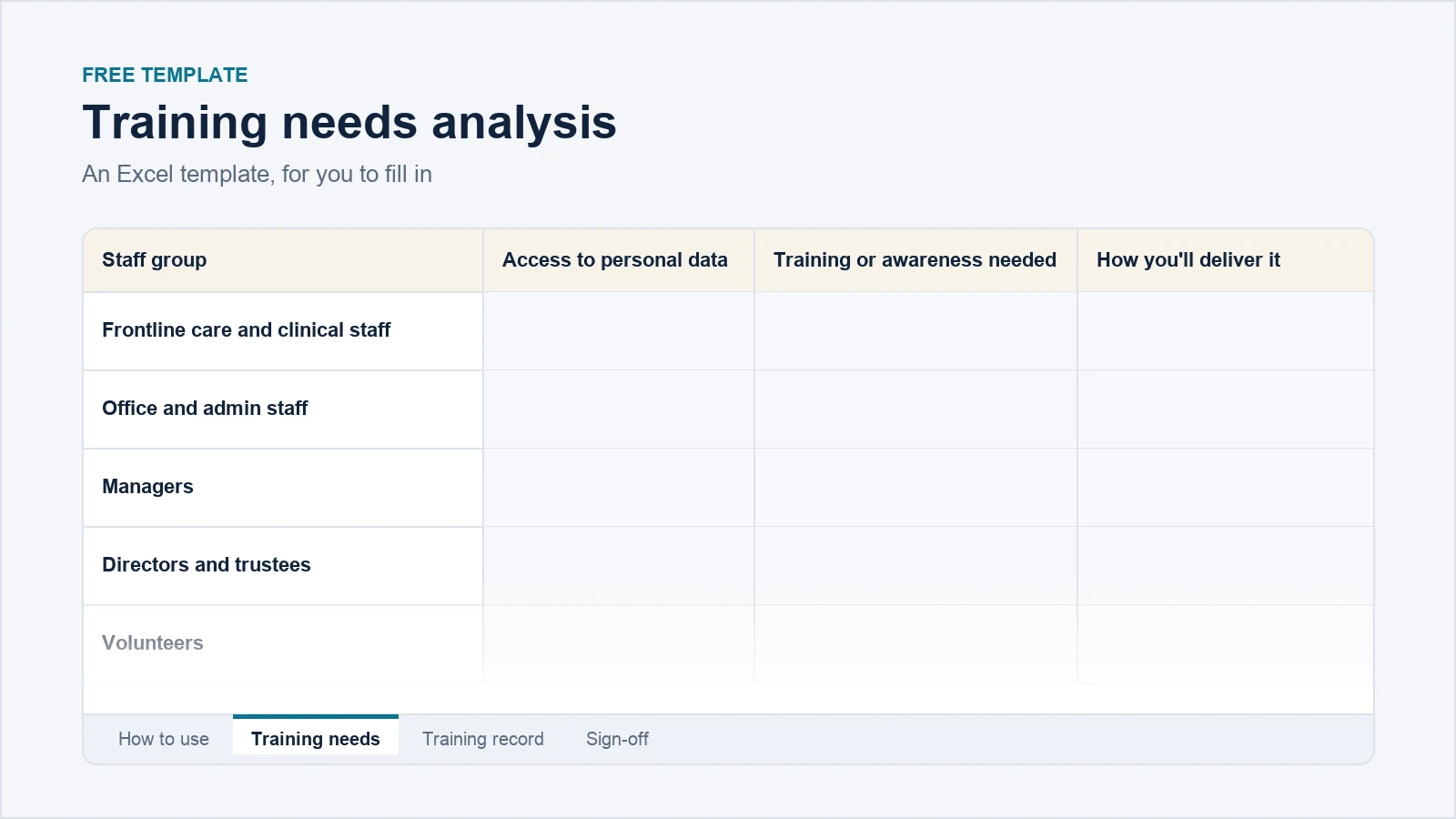
- Who needs training. Every staff group, with directors, trustees and volunteers, and whether each has access to personal data.
- What each group needs. The data security and protection, and cyber security, training or awareness each group needs, and how you’ll deliver it.
- A training record. For checking the 95% over the twelve months before you publish.
- A sign-off. For the person with overall responsibility for data security and protection, with the yearly review date.
An Excel file that also opens in Google Sheets, for you to fill in. It doesn’t include the training or the phishing and scam readiness check.
Request received
Thanks. Our team will be in touch within one working day to send the training needs analysis template.
Could not send that request
Something went wrong on our side. Please try again, or use our contact form and our team will send the template over.
Tailored data security training, with the phishing and scam readiness check
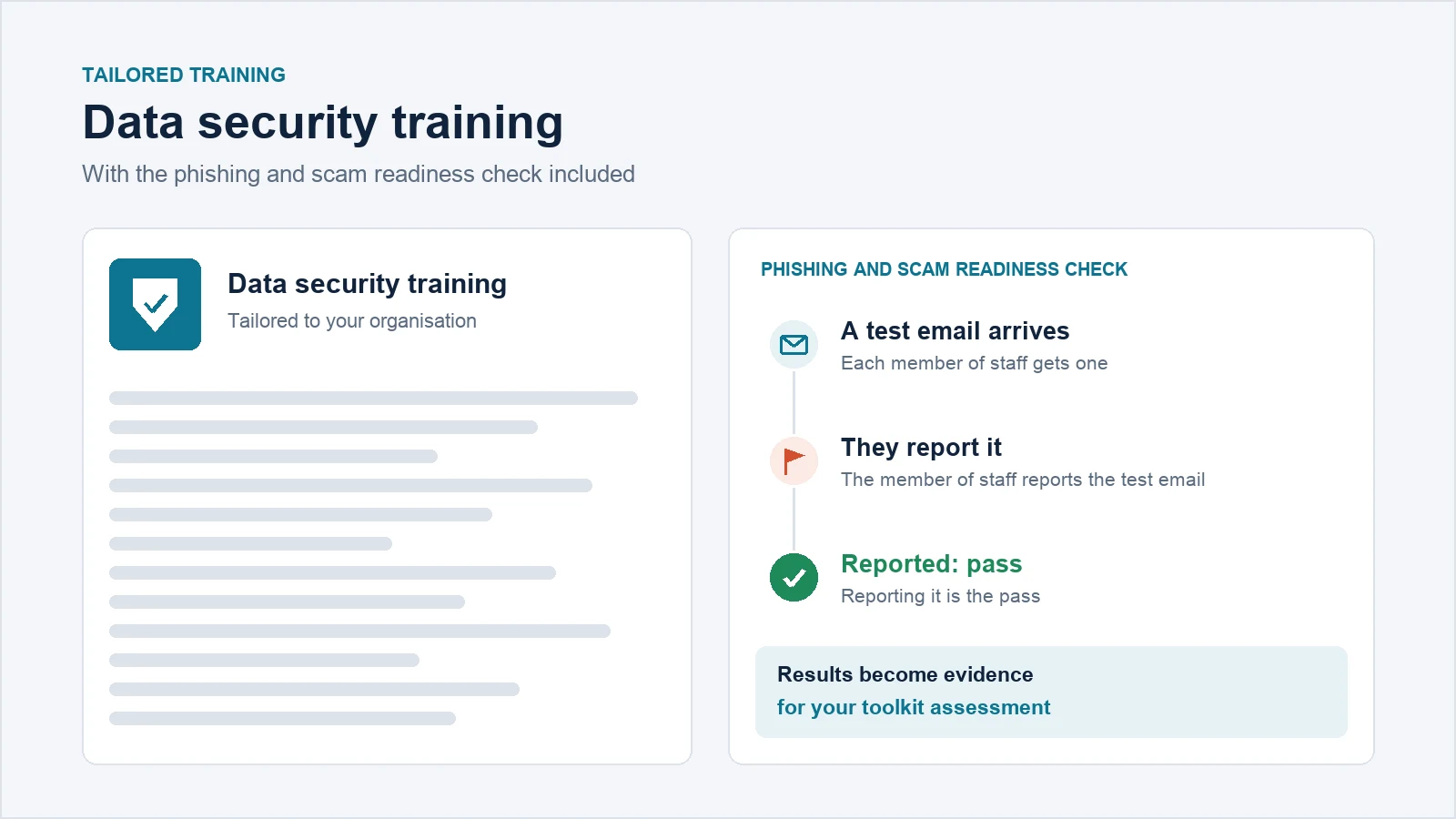
- Data security training, tailored. We tailor the training to your organisation.
- The phishing and scam readiness check, included. Each member of staff gets a test email.
- Reporting it is the pass. Staff who report the test email pass the check.
- Results you can use as toolkit evidence. The results become evidence for your toolkit assessment.
Our team will be in touch with follow-up questions to tailor the training to your organisation.
Request received
Thanks. Our team will be in touch within one working day with follow-up questions to tailor the training to your organisation.
Could not send that request
Something went wrong on our side. Please try again, or use our contact form and our team will be in touch.
The evidence to keep for your assessment
- Your training needs analysis (category 3), from the last twelve months, with the sign-off of the person with overall responsibility for data security and protection. Upload a copy, or record where you keep it.
- A training record for everyone with access to personal data, directors, trustees and volunteers included, with the date each person last trained, so you can show at least 95% trained in the twelve months before you publish.
- Your monthly count of reported phishing emails, if you answer the optional item, from your service desk system or service.
Gaps to check before you publish
- People missing from the count. Directors, trustees and volunteers with access to personal data count towards the 95%.
- An analysis more than a year old. Category 3 providers need a training needs analysis from the last twelve months, which the person responsible reviews or approves every year.
- Training dates outside the window. Training from more than twelve months before you publish doesn’t count.
- Treating the 95% rule as gone. The toolkit’s training page says a new approach replaced it from 2023-24. That change covers category 1 only: care, pharmacy, dental and GP providers still answer the question in 2026-27.
NHS trusts: training that’s tracked, refreshed and changes behaviour
NHS trusts, integrated care boards and the other organisations in category 1 answer a separate, CAF-aligned version of the toolkit. For them, NHS England replaced the 95% target from 2023-24. Its outcome B6, staff awareness and training, checks whether the training changes how people behave:
- Achieved includes: “Each individual’s information assurance training is tracked and refreshed at suitable intervals.”
- Not achieved includes training “used as a ‘silver bullet’ for all user security behaviours”, success “only measured by the number of people reached”, and people who “believe that reporting issues may get them into trouble”.
Or keep everyone’s training up to date all year round
CompliantCare’s Training Suite runs this training for you. Its 40-minute, CPD-certified Information Governance course is ready to assign, reminders reach each person before their training runs out, and every completion is recorded as evidence. When you publish your assessment, your training record is ready.
Common questions
Is phishing training mandatory for the DSPT?
No item in the 2026-27 toolkit for care, pharmacy, dental and GP providers asks for a phishing test or names phishing training. It asks for at least 95% of the people with access to personal data trained in data security and protection, and cyber security, in the last twelve months. As an optional item, it asks how many phishing emails staff report each month. Separately, the ICO's guide to data security expects training that enables staff to recognise phishing attacks.
Does Cyber Essentials require staff training?
Not as a course. The Cyber Essentials requirements (version 3.3, April 2026) cover five technical controls: firewalls, secure configuration, security update management, user access control and malware protection. The only point about educating people is helping them avoid common passwords.
Do directors and volunteers count towards the 95%?
Yes. Item 3.2.1 asks whether at least 95% of "staff, directors, trustees and volunteers" completed training in the last twelve months, and the toolkit's help text says all people with access to personal data must complete it every year.
Is the free Digital Care Hub course enough?
For staff working in adult social care, the toolkit says Digital Care Hub's free Data Security and Protection eLearning course meets the requirement. It names that course for adult social care staff only, and your training needs analysis still sets the level of training each group needs.
What happens if you train fewer than 95% of staff?
The 95% question is mandatory: the toolkit lists it among the items required to meet the standard. If fewer than 95% of the people with access to personal data trained in the twelve months before you publish, you can't answer yes, so your assessment won't meet the standard. The toolkit allows for illness, maternity or paternity leave, people leaving and other reasons, which is why the target is 95%.
Do GP practices need a training needs analysis?
Not in 2026-27. The training needs analysis item (3.1.1) is for category 3: social care providers, CQC market oversight providers, pharmacies, dentists and other providers. GP practices, in category 4, answer the 95% question; the training needs analysis isn't one of their items.
References
- NHS England: Outcomes, Assertions and Evidence items for the Data Security and Protection Toolkit 2026-27, version 9 (2 October 2026)
- NHS England: DSPT 2026-27 version 9 workbook for categories 2, 3 and 4, items 3.1.1, 3.2.1 and 6.2.6 (October 2026)
- NHS England: DSPT 2026-27 version 9 CAF-aligned workbook for NHS trusts, ICBs, ALBs, CSUs and OES, outcome B6 (October 2026)
- NHS England: Staff training, awareness and culture, a major DSPT change (from 2023-24)
- NHS England: Data Security and Protection Toolkit information standard, version 8.0.0 (page updated 13 May 2026)
- NCSC: Phishing attacks, defending your organisation (reviewed 13 February 2024)
- NCSC: Cyber Essentials, Requirements for IT Infrastructure v3.3 (April 2026, PDF)
- ICO: A guide to data security (last updated 19 May 2023)
- Lain, Kostiainen and Čapkun (ETH Zurich): Phishing in Organizations, Findings from a Large-Scale and Long-Term Study, IEEE Symposium on Security and Privacy (2022)
- Ho and others (UC San Diego and UC San Diego Health): Understanding the Efficacy of Phishing Training in Practice, IEEE Symposium on Security and Privacy (2025, PDF)
General information, not legal advice. It reflects our understanding of the law and official guidance as of November 2026, so check the sources above for the current position.