CQC Rating
Received a CQC ‘Requires Improvement’ Rating? What Happens Next and How to Prepare for Re-Inspection
Written by: Tanaka Chamisa
Received a CQC Requires Improvement rating? This guide covers what happens next, what re-inspectors look for, and how to build evidence that moves you to Good.
Getting a “Requires Improvement” rating from the CQC is a turning point.
Not just operationally, but organisationally.
There’s immediate pressure:
from leadership
from regulators
from staff and stakeholders
And the focus quickly shifts to one question: “What do we need to fix and how do we show it’s been fixed?”
Because here’s the reality most providers face:
It’s not just about making improvements.
It’s about being able to prove them clearly, consistently, and at any time.
What happens immediately after a Requires Improvement rating
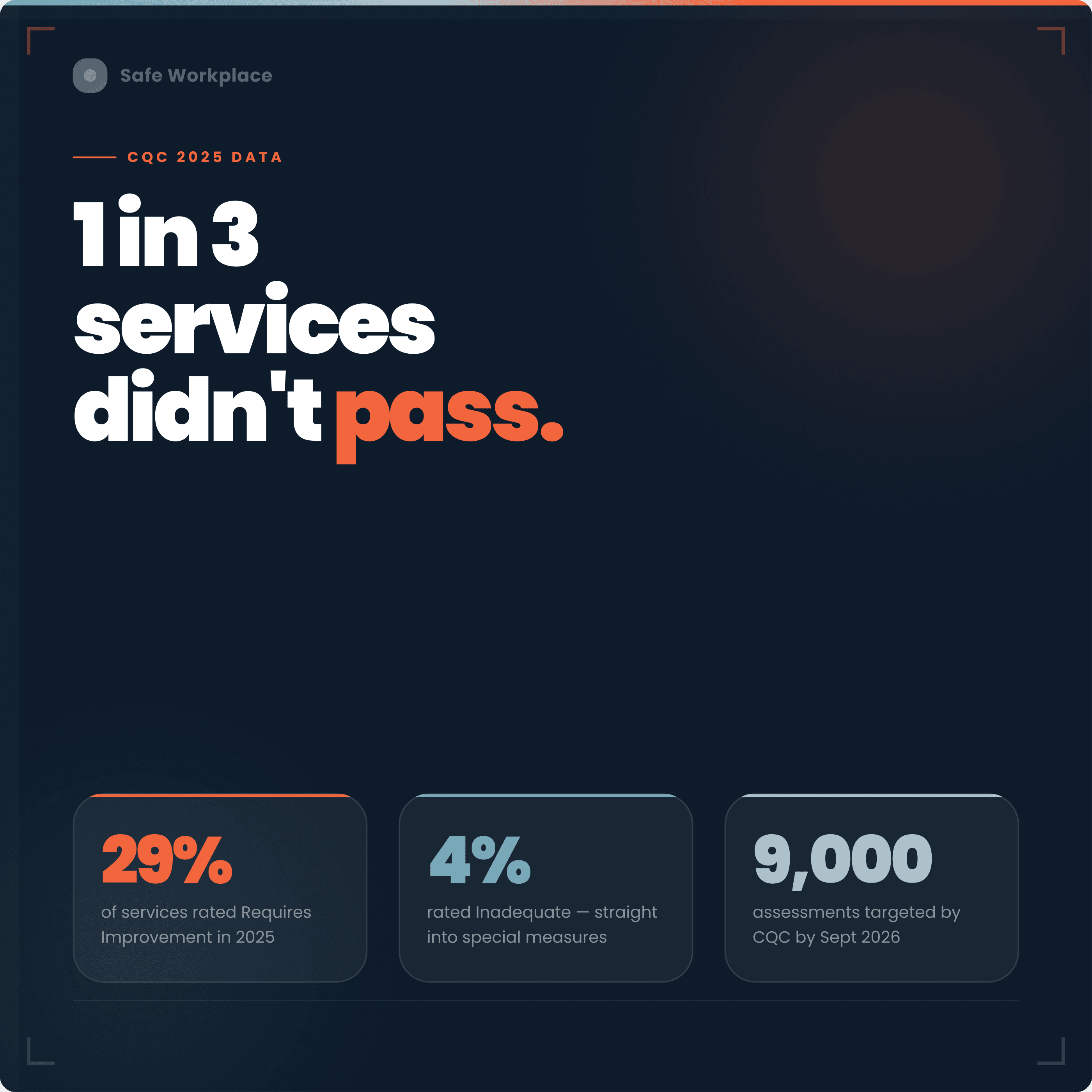
As of 2025, around 29% of health and social care services inspected under the Single Assessment Framework were rated Requires Improvement. Another 4% received Inadequate. That means roughly one in three services inspected did not meet CQC expectations.
This is not rare. It is not a sign that your service is failing beyond repair. But it does mean the next few months matter enormously, and how you spend them will determine whether your re-inspection goes a different way.
The sequence is predictable, and understanding it gives you a framework to work within rather than react to.
After a “Requires Improvement” outcome, most organisations move quickly into action.
Typical next steps include:
Internal reviews across incidents, audits, and care delivery
Action plans to address identified gaps
Increased oversight from leadership
Preparation for re-inspection
All of this is necessary.
But in practice, something important gets missed.
In some cases, particularly where CQC has concerns about specific risks, you may be called into a meeting with your local authority commissioner to discuss the findings and available support. A letter will follow confirming what was agreed, and that letter becomes part of your regulatory record.
Your re-inspection will typically come within 6 to 12 months, though CQC has been running 50% more assessments month-on-month compared to the previous year and is on track to publish 9,000 assessments by September 2026.
The inspection window is tightening. Providers who received their Requires Improvement rating in the past six months should not assume they have the full 12 months before an inspector returns.
If your service received an Inadequate rating at one or more of the five key questions:
Safe
Effective
Caring
Responsive
Well-led
CQC will typically re-inspect that specific domain within six months. An overall Inadequate rating puts your service into special measures immediately, meaning a six-month window to demonstrate sufficient progress before CQC moves toward cancelling your registration.
The Real Challenge: Showing That Improvement Has Happened
Here is what most providers get wrong: they treat the re-inspection as an inspection of whether things have improved. It is not. It is an inspection of whether you can prove things have improved.
That distinction matters enormously in practice. A service can make significant, genuine improvements and still receive the same rating at re-inspection if the evidence is not structured, continuous, and presentable.
CQC inspectors are not simply asking "is this service better?" They are asking: "Does this organisation have the governance systems and culture to sustain safe, effective, person-centred care over time?"
Can you show what changed, not just what was planned?
Can you demonstrate consistency across teams and locations?
Can you prove that issues have been followed through and resolved?
Can you show learning, not just activity?
Because when CQC returns, they’re not looking for intent.
They’re looking for clear, structured, and consistent evidence of improvement
The evidence they need to answer that question is not a report you assembled the week before they arrived. It is a body of documented activity that shows how your organisation learns, responds, and improves continuously.
Under the current Single Assessment Framework, inspectors look at six categories of evidence:
People's experience
Staff and leadership feedback
Feedback from partners
Observation
Processes
Outcomes.
When they arrive at a re-inspection, they are examining whether each of those categories tells a coherent, consistent story. A good audit log that contradicts what staff say in conversation is a problem. A strong incident-reporting culture without corresponding evidence of action taken is a problem.
Individual improvements that are not connected to updated policies and staff training are a problem.
The question to ask yourself right now is not "have we improved?"
It is: "If an inspector sat down with our records today, could they trace the thread from what went wrong, through what we decided to do, to what changed, to who was trained, to the evidence that the change is embedded?" If the answer is not a confident yes, the re-inspection carries risk regardless of how much genuine improvement your team has made.
What CQC inspectors actually look for
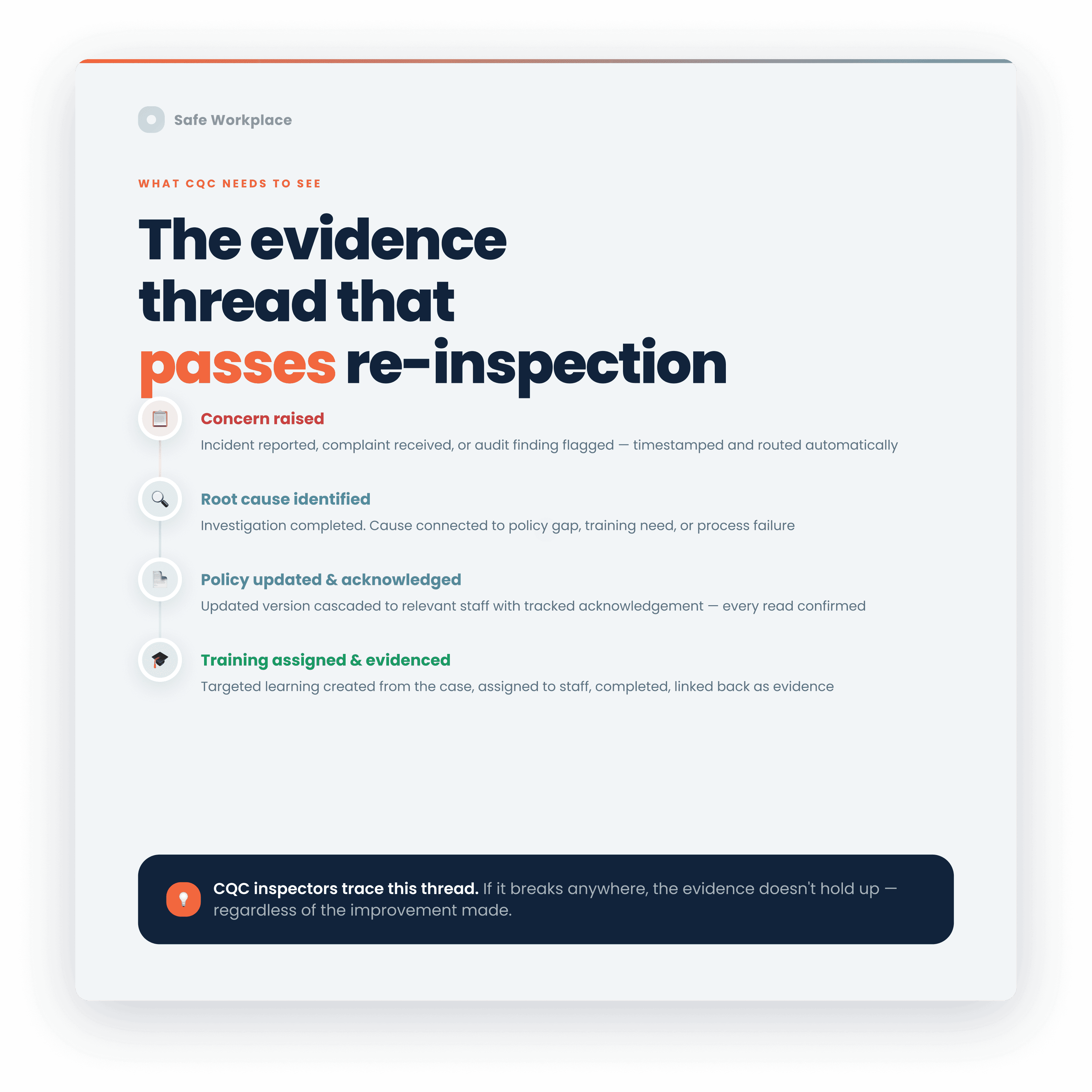
There is a specific type of evidence trail that CQC inspectors recognise immediately as a sign of a Well-led service. It goes like this:
A concern is raised: through incident reporting, a staff concern, a complaint, or an audit finding.
That concern is investigated. The investigation produces a root cause. The root cause connects to a policy gap, a training need, or a process failure.
That gap is addressed. Staff are trained. The policy is updated and acknowledged. The audit activity in the following weeks confirms the issue has been resolved. And the whole thread is documented, timestamped, and traceable.
When an inspector can follow that thread through your records, end to end, across multiple examples, they are looking at a service that has embedded continuous improvement into its governance.
That is what moves a service from Requires Improvement to Good. Not any single action, but the demonstrable culture of identifying, addressing, and evidencing.
The providers who struggle with re-inspection are not usually the ones who failed to make changes. They are the ones whose changes live in different places, improvements noted in emails, training logged in a separate system, policies updated but not formally acknowledged, incidents recorded but not connected to the actions they prompted.
When an inspector has to ask "where is the evidence for this?" and the answer involves retrieving documents from multiple systems or asking different members of staff, that is a governance problem in itself.
From 16 incidents a month to 400+ audit-ready data points: what this looks like in practice
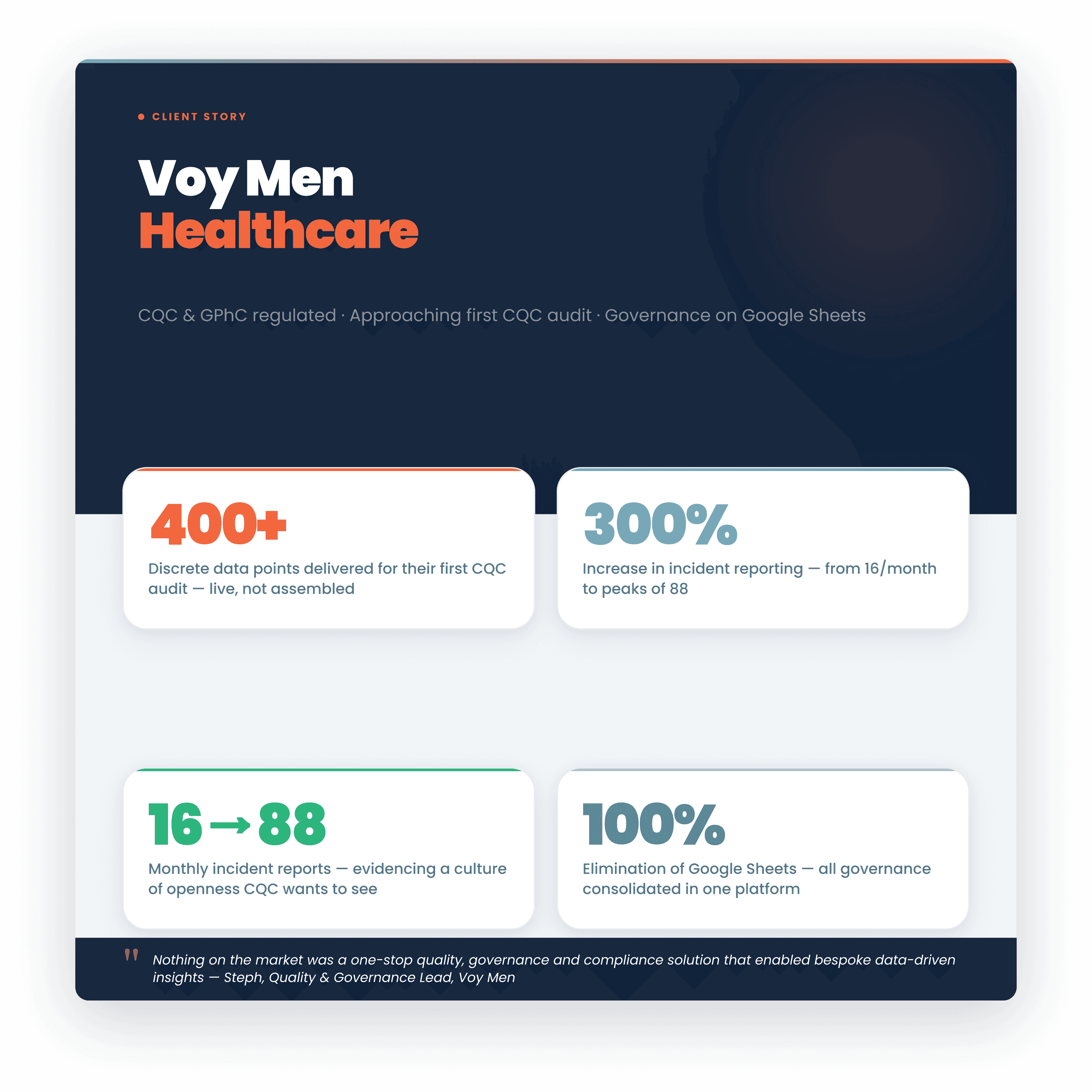
Voy Men approached Safe Workplace ahead of their first CQC audit. They were CQC and GPhC regulated, scaling rapidly, and building their governance infrastructure from scratch.
Incident reporting lived in Google Sheets. Investigations were scattered across emails and forms. There was no structured way to escalate, track actions, identify trends, or demonstrate learning.
Before Safe Workplace, the organisation was averaging 16 incident reports a month.
“This did not mean we were amazing, and there were no incidents; it meant incident reporting, learning and improving were not a priority. If I see low incident numbers, I go digging. No one is that good.” - Steph, Quality & Governance Lead
Within twelve months of implementing Safe Workplace, monthly incident reports had climbed to a peak of 88. In healthcare, that sounds counterintuitive. But high reporting of low-harm incidents is precisely what CQC looks for as evidence of an open, transparent, learning culture.
It signals that staff feel safe raising concerns, that the organisation is capturing near misses before they become serious events, and that leadership has the data to identify patterns and act on them.
By the time their CQC audit arrived, Voy Men's team had produced over 400 discrete data points covering incident trends, root cause analysis, action completion rates, risk register status, policy compliance, and evidence of learning. None of it was assembled the night before. It was live, structured, and audit-ready at all times. The evidence was there when the inspector arrived because the system had been building it continuously since day one.
That is what the shift from reactive to inspection-ready actually looks like.
A practical framework for the next 90 days
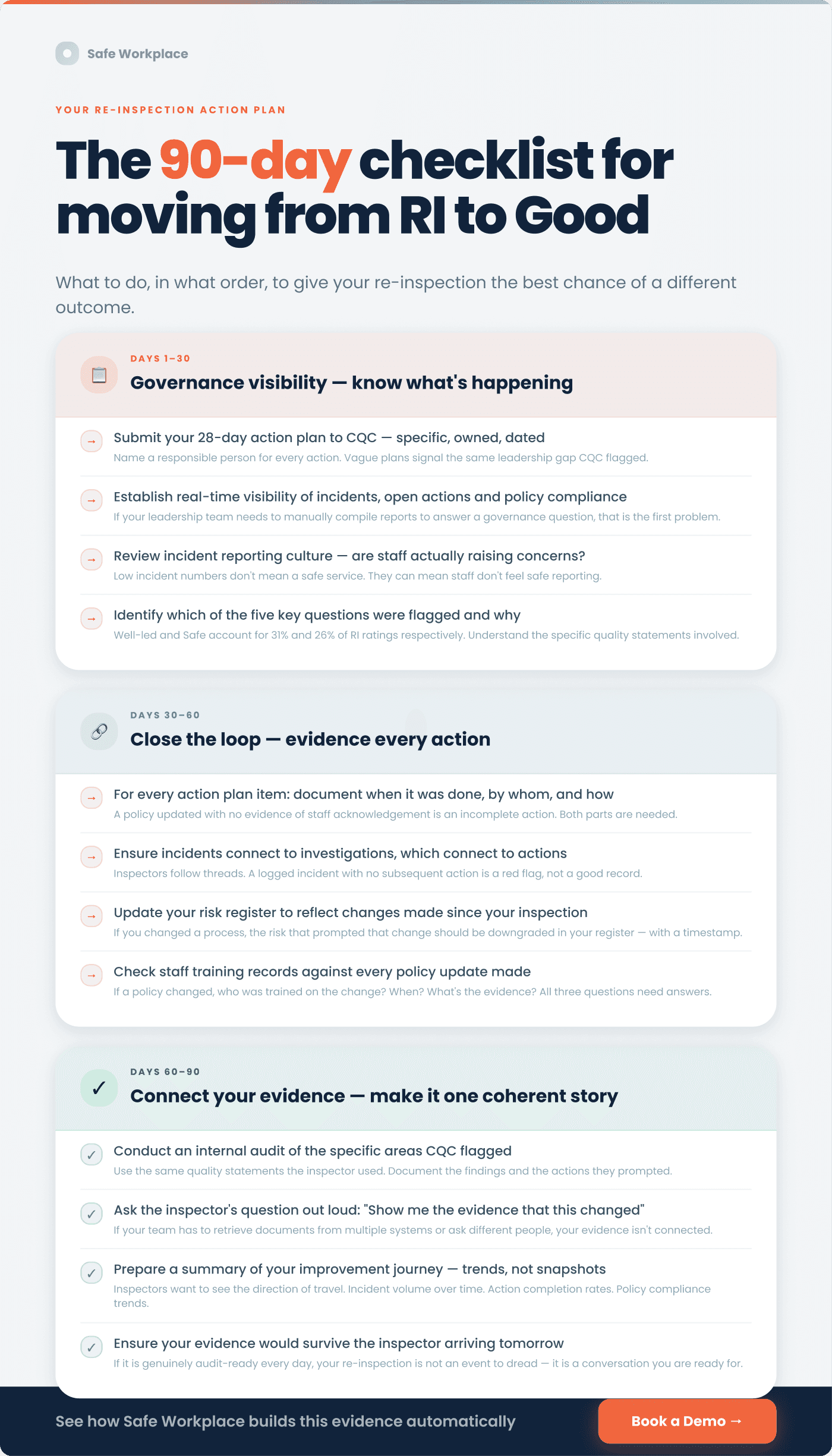
If your re-inspection is within 6 to 12 months, here is where to focus.
The first 30 days: Governance visibility.
Your leadership team needs real-time visibility of what is happening across the service. If your current systems require someone to manually compile information from multiple sources to answer a question about incident volumes, open actions, or policy compliance, that is the first thing to address. You cannot improve what you cannot see, and CQC cannot assess improvement that they cannot evidence.
Days 30 to 60: Close the loop on your action plan
Every item in your CQC action plan should now have a named owner, a completion date, and a mechanism for evidencing that it was done. If an action was "update medication policy," the evidence trail should show when the policy was updated, who reviewed it, when it was circulated to staff, and which staff members acknowledged it. If an action was "improve incident reporting culture," the evidence is the incident data, volume trends over time, alongside evidence of the learning those incidents prompted.
Days 60 to 90: Connect your evidence
The most common gap at re-inspection is not the absence of improvement but the absence of connection. Your incidents should connect to your risk register. Your audits should connect to your action plans. Your policy updates should connect to your training records. Your training completion should connect back to the original concern that prompted the training. Inspectors are looking for a system, not a collection of separate processes. If your evidence cannot be navigated as a coherent whole, use the next 30 days to build those connections deliberately.
The question of continuous monitoring in 2026
One development worth understanding is the direction CQC is heading with its assessment approach. The regulator is on track to publish 9,000 assessments by September 2026, a +/- 50% increase in inspection activity compared to the same period last year.
More importantly, the philosophy underpinning the new sector-specific frameworks being developed for late 2026 makes explicit what inspectors have been moving toward for some time: that good governance is not evidenced in an inspection folder. It is evidenced in the way an organisation operates every single day.
The providers who will be best positioned for re-inspection under whatever framework CQC lands on are not the ones who scramble to prepare when an inspector calls.
They are the ones whose evidence of safe, well-led practice is continuous, structured, and already in the format the regulator needs to see it.
Is your evidence ready?
Safe Workplace was built specifically for regulated healthcare providers who need their governance to work continuously, not just when the CQC is coming.
The platform connects your incidents, audits, policies, risk register, and staff training in one place. When a concern is raised, it creates a thread. That thread follows the concern through investigation, root cause, action, policy update, training, and completion, automatically, without anyone chasing it across systems. When an inspector asks what changed after a specific incident, the answer is one click away.
Our clients across adult social care, independent healthcare, and NHS-regulated providers use Safe Workplace to build the kind of evidence trail that moves services from Requires Improvement to Good, not by gaming the inspection, but by making continuous improvement the way the organisation works.
If you are not confident that your evidence would hold up if an inspector arrived tomorrow, it is worth seeing what that looks like in practice.
Book a 20-minute demo → we will walk through your specific governance challenges, not a generic presentation.
Not ready for a meeting yet? Explore the platform yourself in under 5 minutes
FAQs about CQC ratings
1. What should you do after receiving a ‘Requires Improvement’ CQC rating?
After receiving a Requires Improvement rating, organisations should focus on two things: fixing issues and evidencing improvement.
This typically involves:
reviewing incidents, audits, and complaints
creating clear action plans
assigning ownership and deadlines
tracking follow-up actions to completion
However, the most important step is ensuring you can demonstrate what has changed. CQC inspectors will expect to see not just plans, but clear evidence of improvement over time.
2. How do you prepare for a CQC re-inspection?
Preparing for a CQC re-inspection isn’t about last-minute preparation, it’s about continuous readiness.
Key areas to focus on include:
consistent incident and investigation processes
clear documentation of actions and outcomes
evidence of learning and improvement
visibility of risks and trends across the organisation
Teams that perform well in re-inspections are those that can show structured, real-time evidence, rather than assembling it just before inspection.
3. What evidence does CQC look for during inspections?
CQC inspectors look for clear, structured, and consistent evidence that demonstrates how an organisation operates.
This includes:
incident reports and investigation records
actions taken and whether they were completed
audit results and follow-up activities
staff training records
evidence of learning and changes made
Crucially, inspectors want to see how these elements connect, showing a clear line from issue → action → outcome → improvement.
4. Why do organisations struggle to improve their CQC rating?
Most organisations don’t struggle to make improvements, they struggle to prove those improvements clearly.
Common challenges include:
information spread across multiple systems
inconsistent processes between teams
manual tracking of actions and follow-ups
lack of a clear audit trail
This makes it difficult to demonstrate consistency, accountability, and learning — all of which are critical for improving a CQC rating.
5. What systems help with CQC compliance and inspection readiness?
Organisations are increasingly using connected governance and compliance platforms to support CQC readiness.
These systems help by:
standardising incident and investigation workflows
tracking actions and escalations automatically
centralising audits, risk, and training data
providing real-time dashboards and insights
The goal is to ensure that evidence is continuously available and structured, rather than manually compiled ahead of inspections.