
Sexual harassment training: a free pack for UK employers, ready for 30 October 2026
Two ready-to-present sessions for staff and managers, a quiz with a training record, and a rollout guide, built from EHRC guidance and free by email. Or have us tailor it and run it for you, on a branded company site with your training content, from £399.
From 30 October 2026, employers must take all reasonable steps to prevent sexual harassment, including by customers, clients and patients. Training is one of the steps the EHRC expects.
Take the free pack and run it yourself, or have us tailor it and run it for you: a branded company site with your training content, every member of staff invited and reminded by email, and a certificate for every completion, from £399 per company.
| Question | Short answer |
|---|---|
| Is training required? | No law names it, but the EHRC expects it as part of the duty to prevent sexual harassment. |
| Who needs it? | Everyone, plus extra training for managers, and for staff who deal with the public. |
| What must it cover? | All three types of harassment and victimisation, what to do, and harassment by third parties where it’s likely. |
| How often? | At regular intervals. We suggest once a year. |
| What to keep | A record of who has been trained, and when. |
What the law expects of your training
Since 26 October 2024, employers must take reasonable steps to prevent sexual harassment of their staff. On 30 October 2026, that becomes all reasonable steps, and employers must also take all reasonable steps to stop customers, clients, patients and other third parties harassing staff. The EHRC’s guidance sets out what training should do:
- Cover all three types of harassment and victimisation, tailored to your organisation, your people and your policy.
- Teach everyone what acceptable behaviour looks like, how to recognise harassment, and what to do if they experience or witness it.
- Train managers further on receiving reports, investigations, discipline and supporting the people involved.
- Cover third parties where staff are likely to face harassment from customers, clients or patients.
- Keep records of who has been trained, and refresh training at regular intervals.
- Check it worked, and offer refresher sessions.
Training only counts if people understand it. The EHRC points to a case where training had gone stale and staff no longer understood it, so it didn’t help the employer. What’s reasonable also depends on your size: the EHRC accepts that a very small employer may not need paid training. Our guide to the duty to prevent sexual harassment covers the other seven steps.
What you’ll get
Run the free pack yourself, or have us tailor it to your organisation and run it for you.
| Free pack | Tailored and run for you, from £399 | |
|---|---|---|
| The content | Complete the general training template | Tailored to your organisation for you |
| How staff complete it | Staff and manager slides with speaker notes, a quiz and a rollout guide, to deliver however suits you | A branded company site with your training content loaded for all staff to complete |
| Getting it to staff | You organise it | Every member of staff emailed for you |
| Reminders and chases | No automation included | Reminders and chases automated for you |
| Certificate of completion | Not included | A dated certificate for every person who completes it |
| Cost | Free | From £399 per company |
The free pack, file by file
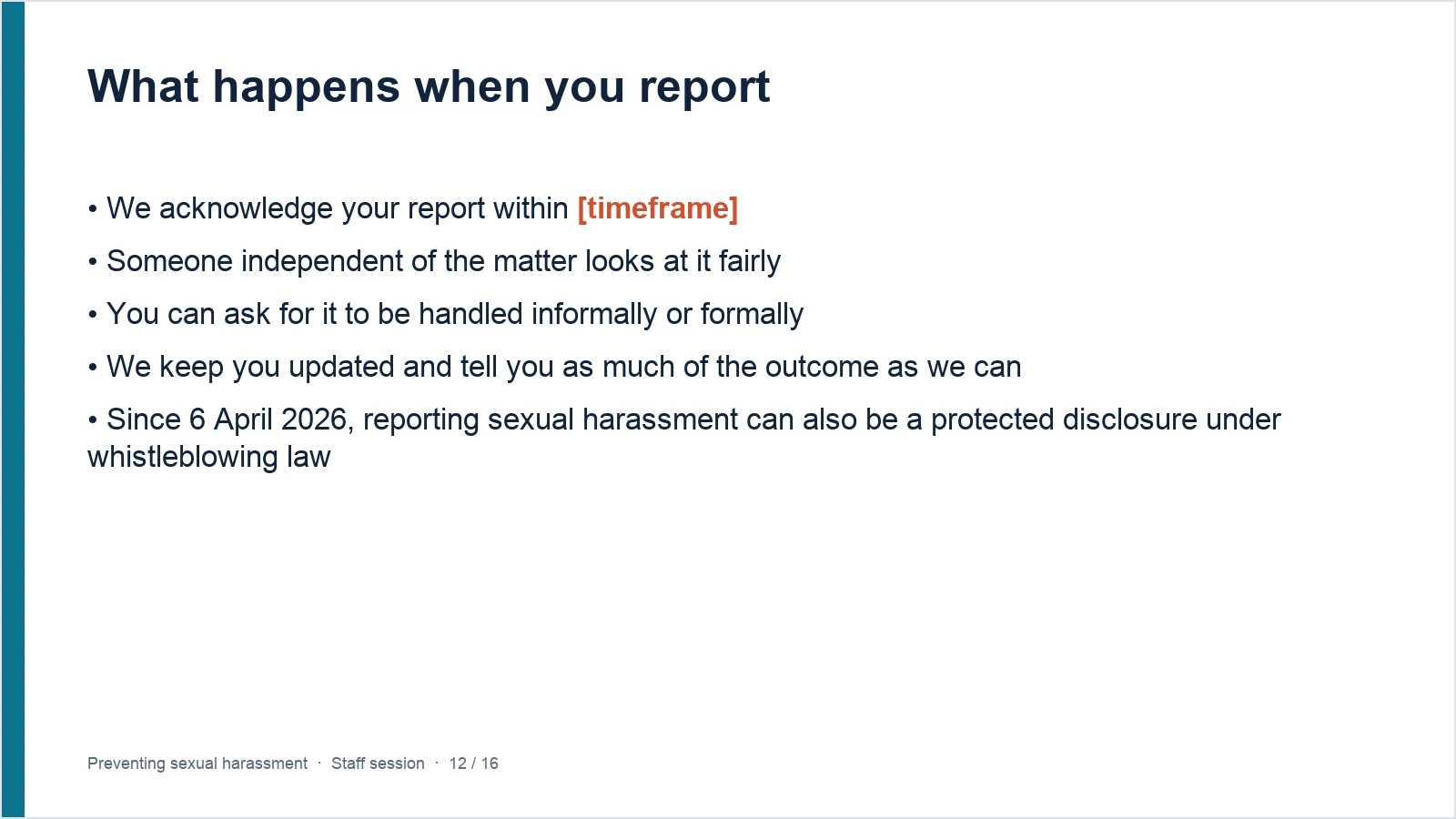
- Staff session. PowerPoint, 16 slides, about 30 minutes, with speaker notes on every slide.
- Manager briefing. PowerPoint, 10 slides, about 20 minutes, with speaker notes.
- Quiz and training record. Word: 10 questions, an answer sheet for the presenter, and a training record for everyone to sign.
- Rollout guide. Word: how to tailor, deliver, record, refresh and check the training, with three survey questions.
You fill in the gaps, present the sessions, chase completion and keep your own records. It doesn’t include a certificate of completion.
The tailored training, part by part
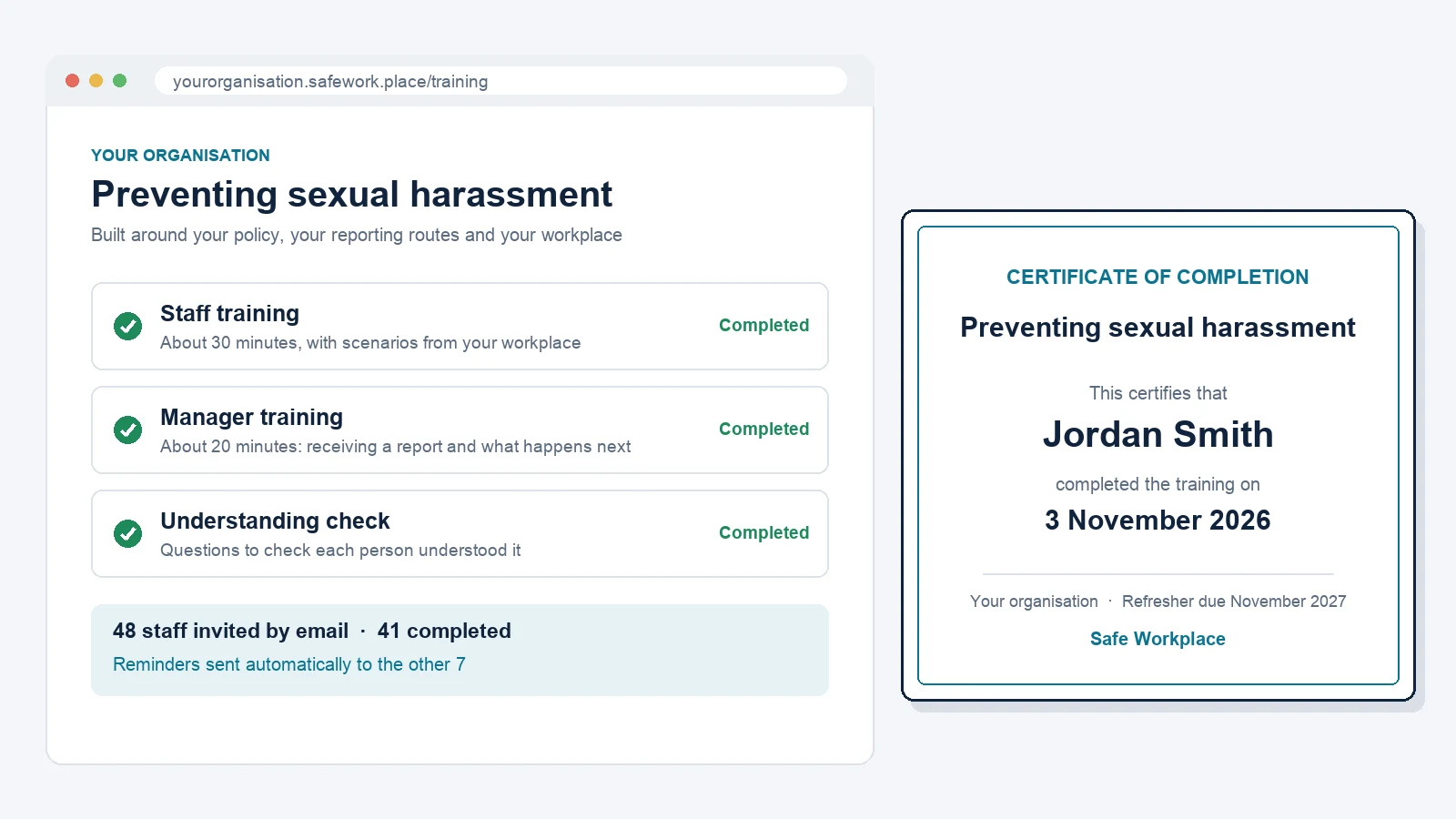
- Tailored to your organisation. We tailor the training content to your organisation, its processes and likely scenarios.
- A branded company site. Your training content loaded, with an understanding check, ready for all your staff to complete.
- Distribution taken care of. Invite all your staff, and each person gets an email to complete the training.
- Reminders and chases, automated. We remind anyone who hasn’t finished until they complete it.
- A certificate for every completion. A dated certificate for each person who completes it, to save for your records.
Our team will be in touch with follow-up questions to tailor the content to your organisation.
What the training covers
Staff session (after the title slide):
- Why we're talking about this
- What the law says
- What harassment means
- What sexual harassment can look like
- It doesn't have to happen in the office
- Harassment by people who don't work for us
- Victimisation
- If it happens to you
- If you see it
- Why people stay quiet, and what we do about it
- What happens when you report
- Scenarios to discuss
- In health and care settings
- Where to go
- Recap
Manager briefing:
- Your part
- It might not sound like a complaint
- The first conversation
- Things to avoid
- What happens next
- Harassment by people who don't work for us
- Protecting people who speak up
- Records and refreshers
The free pack’s staff session includes one slide for health and care settings, on harassment by patients, residents and relatives. Delete it if it doesn’t apply to you.
Sample quiz questions
Three of the ten questions, with the answers from the presenter’s sheet:
- True or false: it only counts as harassment if the person meant to cause offence. True / False.
Answer: False. The law looks at the purpose or the effect. How the person saw it, the circumstances and whether the effect was reasonable all count. - A colleague turns down a manager's advances and is then left out of the next project. What is this? A workload decision / Harassment / A problem only if it happens again.
Answer: Harassment. Treating someone worse because they rejected unwanted sexual conduct is harassment. - True or false: harassment at after-work drinks with colleagues can't count because it's outside work. True / False.
Answer: False. Work social events can count, and our policy covers them.
Request the free training pack
Enter your work email and the team will send you the template: the staff session and manager briefing (PowerPoint), and the quiz with training record and the rollout guide (Word), for you to fill in and run.
Request received
Thanks. The team will send the four files to your inbox within one working day.
Could not send that request
Something went wrong on our side. Please try again, or use our contact form and we'll get the scoped copy over.
Get it tailored and run for you
Enter your work email and we'll tailor the training to your organisation and set up a branded company site with your training content: every member of staff invited by email, reminders and chases sent automatically, and a certificate for every completion. From £399 per company. Our team will then be in touch with follow-up questions to tailor the content.
Request received
Thanks. Our team will be in touch within one working day with follow-up questions to tailor the training to your organisation.
Could not send that request
Something went wrong on our side. Please try again, or use our contact form and we'll get the scoped copy over.
After the training
Check it worked. A few weeks later, ask staff three questions anonymously, and look at the answers alongside your complaints log:
- Do you know where and how to report a concern about harassment?
- Do you know where to find our harassment policy?
- Have you ever decided not to report inappropriate behaviour you experienced or saw?
Keep the rest in place. Training is one of the EHRC’s eight steps. It works alongside your policy, risk assessment, reporting routes and complaints procedure. Reporting sexual harassment can also be a protected disclosure under whistleblowing law. Our UK whistleblowing policy guide covers what your policy should say, and our psychological safety guide covers what makes people feel able to report.
Or give staff a safe way to raise sexual harassment concerns
Only 15% of people sexually harassed at work in the past year reported it formally (Government Equalities Office, 2020). Training shows staff what to do. CalmER gives them safe, trusted routes to do it: a hotline, app, web form, WhatsApp, Slack or Teams, named or anonymous, with every concern logged from day one, so you hear about it while you can still act.
Last reviewed: 14 October 2026. General information, not legal advice. We review this pack when the EHRC updates its guidance and when the government makes the reasonable-steps regulations.
Common questions
Is sexual harassment training mandatory in the UK?
No law says in so many words that you must train staff. But employers must take reasonable steps to prevent sexual harassment, and all reasonable steps from 30 October 2026, and the EHRC's guidance expects training for all workers, with extra training for managers. Training is one of the eight steps in the EHRC's guide for employers.
How often should sexual harassment training be refreshed?
The law sets no interval. The EHRC says training should be refreshed at regular intervals, and it points to a case where old training had gone stale and no longer helped the employer. We suggest once a year, and sooner after an incident or a change to your policy.
How long should the training be?
There's no set length. This pack's staff session takes about 30 minutes and the manager briefing about 20 minutes. What matters more is that people understand it: the EHRC points to a case where training staff didn't understand didn't count.
Who needs sexual harassment training?
Everyone who works for you, including managers, who also need to know how to receive and handle a report. Staff who deal with customers, clients or patients need to know what to do about harassment from them.
Do we need training on harassment by customers or patients?
From 30 October 2026, employers must take all reasonable steps to prevent third parties, such as customers, clients and patients, harassing their staff. The EHRC expects training where staff are likely to face it. The staff session and manager briefing in this pack both cover it.
What's in the free training pack?
Four editable files: a staff session (PowerPoint, 16 slides, about 30 minutes, with speaker notes), a manager briefing (PowerPoint, 10 slides, about 20 minutes), a 10-question quiz with answers and a training record to sign (Word), and a rollout guide (Word).
What's the difference between the free pack and the tailored training?
The free pack is the template: four editable files you fill in, present and record yourself, with no certificate of completion. The tailored training is built for your organisation and run for you: a branded company site with your training content, every member of staff invited by email and reminded until they complete it, and a dated certificate for every completion.
Can we add our own branding?
Yes. The slides use a plain design so you can add your logo and colours. Fill in the parts in square brackets with your own names, reporting routes and timeframes.
References
- Equality Act 2010, section 26: harassment
- Equality Act 2010, section 27: victimisation
- Equality Act 2010, section 40A: employer duty to prevent sexual harassment
- Equality Act 2010, section 110: liability of employees
- Employment Rights Act 2025, section 20: all reasonable steps
- Employment Rights Act 2025, section 21: harassment by third parties
- Employment Rights Act 2025, section 23: whistleblowing on sexual harassment
- EHRC: Sexual harassment and harassment at work, technical guidance (updated 26 September 2024)
- EHRC: Employer 8-step guide to preventing sexual harassment at work
- Acas: Preventing sexual harassment
- Acas: Third-party harassment law changes
- Government Equalities Office: 2020 Sexual Harassment Survey (July 2021)
General information, not legal advice. It reflects our understanding of the law and of EHRC and Acas guidance as of October 2026, so check legislation.gov.uk and equalityhumanrights.com for the current position.